Category Archives: Science

Teachers join UGA Skidaway Institute research cruises

JoCasta Green became a teacher after she was told as a child she couldn’t be a scientist because she was a girl. In May, the pre-K teacher from Decatur, Georgia, achieved a small piece of her childhood dream by joining a research cruise on board the University of Georgia Skidaway Institute of Oceanography’s Research Vessel Savannah. Green was one of two teachers on the overnight cruise, some of the first to participate in a cooperative program between UGA Skidaway Institute and Georgia Southern University’s Institute for Interdisciplinary STEM Education (i2STEM).

“Because I am an elementary teacher, I was afraid that maybe I shouldn’t have applied,” Green said. “However, once I got here and everyone was so interested and wanted to share, I really did learn a lot.”
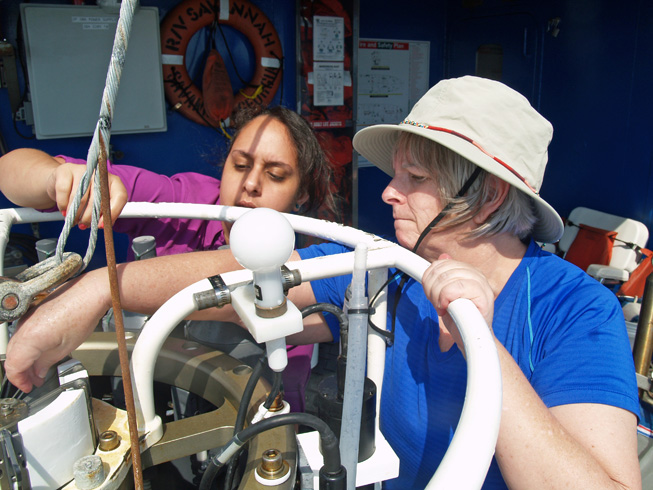
Green (left) learns to set the spring-loaded bottle plugs on a conductivity-temperature-depth sensor array with the help of Natalia Lopez Figueroa from Hampton University.

JoCasta Green (right) learns how to prepare a conductivity-temperature-depth sensor array for deployment with the help of Natalia Lopez Figueroa from Hampton University.

UGA Skidaway Institute scientist Marc Frischer led the cruise with the aim to hunt, collect and study doliolids — a small gelatinous organism of great significance to the ecology and productivity of continental shelf environments around the world. Green and middle school teacher Vicki Albritton of Savannah were the only teachers on board and were able to actively participate in the research activities.

“I think giving any teacher the opportunity come to out to sea is an amazing experience,” Frischer said. “I think it’s transformative, but to have them integrated into the research, we haven’t really done that before.”
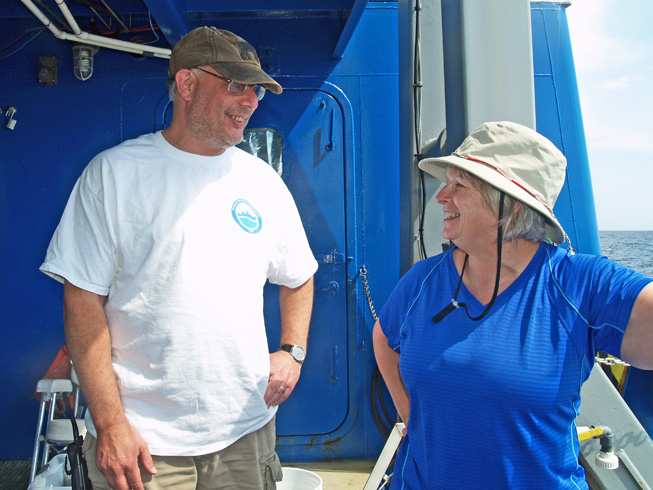
Marc Frischer chats with JoCasta Green during the cruise.

Marc Frischer chats with JoCasta Green during the cruise.

Green and Albritton participated in the deck activities. They helped launch the CTD (conductivity-temperature-depth) sensor packages mounted on heavy metal frames and deployed plankton nets that concentrated a wide variety of tiny marine creatures into a small container. The two teachers then worked with the science team in the darkened wet lab to sort through gallons of water and to isolate the doliolids they were seeking.

“I was hoping to see science in action, and I did that all day long,” Albritton said. “I got to participate and learn what was going on and take many pictures, and now I have a wealth of information to take back to the classroom.”

Albritton says an experience like the cruise raises teachers’ credibility in the classroom, because the students see the teachers going out to learn more themselves. “If I want them to be perpetual learners, then I need to demonstrate that same trait,” she said.

Although Green admitted she was nervous about the cruise initially, she credited the scientists with making her comfortable. “They were great teachers,” she said. “I understood what we were doing and why we were doing it.”

Albritton echoed Green’s thoughts and cited the graciousness of everyone she encountered on the cruise. “There wasn’t condescension or an implication that we didn’t know anything,” she said. “There was genuine respect for all of us as professionals in our fields. That was really wonderful.”

A research cruise on the 92-foot R/V Savannah will never be confused with a luxury vacation cruise. Green and Albritton agreed the food was good, but the working spaces were tight and the bunks and cabins even more so.

Green and Albritton were the second group of teachers to join an R/V Savannah research cruise through the partnership with Georgia Southern’s i2STEM program. The goal of the i2STEM program is to improve the teaching and learning of science, technology, engineering and mathematics at all levels from kindergarten through college throughout coastal Georgia.
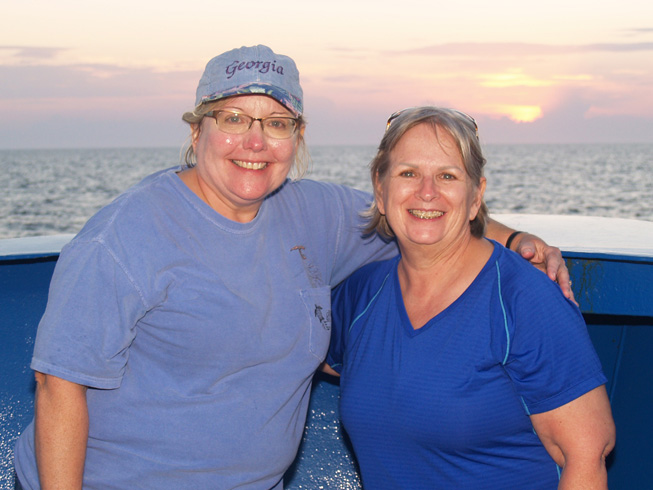
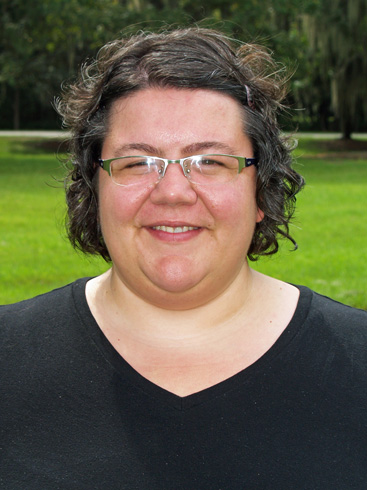
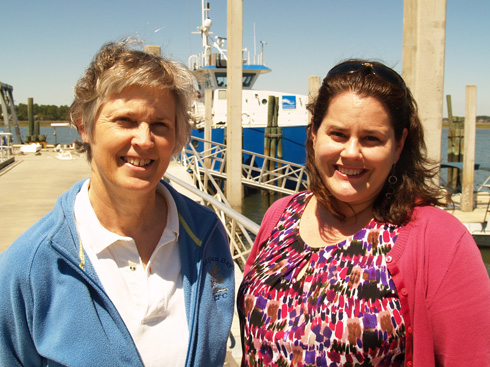
Vicki Albritton (left) and JoCasta Green

Vicki Albritton (left) and JoCasta Green

The partnership between UGA Skidaway Institute and i2STEM is expected to grow. Five additional doliolid cruises are scheduled this year with space available for as many as four teachers on each cruise. UGA Skidaway Institute will also offer two half-day cruises this month as part of i2STEM’s summer professional development workshop for teachers.

According to Frischer, the ultimate goal of scientific research is to generate and communicate information. “Teachers are some of our most important communicators,” he said. “They communicate to the next generation, so I think it is really special to be able to bring teachers right to where the research is happening. It gives them a total perspective, not only on what we are doing, but how research works and to communicate that to their students.”

Both Green and Albritton said they would encourage their fellow teachers to take advantage of opportunities like this. “You would be crazy not to, in terms of learning and what you can bring back to the kids in your classroom,” Albritton said. “It’s an experience you will never forget.”
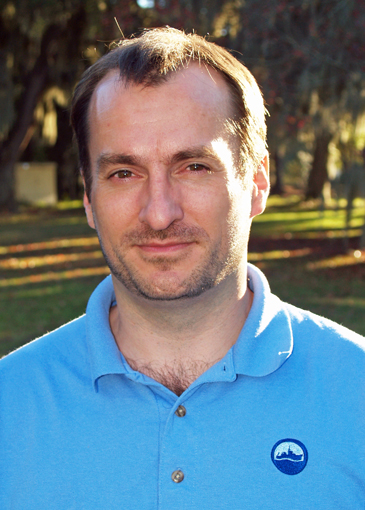
Molecular-level relationships key to deciphering ocean carbon

by Alan Flurry

From beach shallows to the ocean depths, vast numbers of chemical compounds work together to reduce and store atmospheric carbon in the world’s oceans.

In the past, studying the connections between ocean-borne compounds and microbes has been impractical because of the sheer complexity of each. Three University of Georgia faculty members—along with an international team of scientists—bring to the forefront technological developments that are providing scientists with the analytical tools needed to understand these molecular-level relationships.

Their perspective article appears March 7 in the Proceedings of the National Academy of Sciences. It focuses on dissolved organic matter, or DOM, in the world’s oceans as a central carbon reservoir in the current and future global carbon cycle.

“Dissolved organic carbon is an amazing and confounding molecular soup,” said Aron Stubbins, co-author and associate professor of marine sciences at UGA housed at the Skidaway Institute of Oceanography in Savannah. “It sits at the center of the ocean carbon cycle, directing the energy flow from the tiny plants of the sea, phytoplankton, to ocean bacteria. Though around a quarter of all the sunlight trapped by plants each year passes through dissolved organic carbon, we know very little about the chemistry of the molecules or the biology of the bacterial players involved.”

The carbon the microbes process is stored in seawater in the form of tens of thousands of different dissolved organic compounds.

Researchers thought they had a handle on how some aspects of the process works, but “a number of new studies have now fundamentally changed our understanding of the ocean carbon cycle,” said the paper’s lead author Mary Ann Moran, Distinguished Research Professor at UGA.

In the context of methodological and technological innovations, the researchers examine several questions that illustrate how new tools—particularly innovations in analytical chemistry, microbiology and informatics—are transforming the field.

From how different major elements have cycles linked though marine dissolved organic matter to how and why refractory organic matter persists for thousands of years in the deep ocean to the number of metabolic pathways necessary for microbial transformation, the article infers a scale of enhanced and expanded understanding of complex processes that was previously impractical.

The perspective article, “Deciphering Ocean Carbon in a Changing World,” was shaped in discussions at a 2014 workshop supported by the Gordon and Betty Moore Foundation and Microsoft Research Corporation. Moran’s research has been supported by the Gordon and Betty Moore Foundation’s Marine Microbiology Initiative.

Co-authors on the paper include UGA’s Patricia Medeiros, assistant professor in the department of marine sciences. Others involved are with the Woods Hole Oceanographic Institute; the Scripps Institute of Oceanography and the Skaggs School of Pharmacy and Pharmaceutical Sciences, University of California, San Diego; University of Tennessee, Knoxville; Oregon State University; Columbia University; The Pacific Northwest National Laboratory, Richland Washington; the University of Washington; University of Oldenburg, Germany; Sorbonne Universités; and the University of Chicago.


UGA Skidaway Institute scientists study dynamic Cape Hatteras waters

Sometimes called the “graveyard of the Atlantic” because of the large number of shipwrecks there, the waters off of Cape Hatteras on the North Carolina coast are some of the least understood on the U.S. eastern seaboard. University of Georgia Skidaway Institute of Oceanography scientist Dana Savidge is leading a team, which also includes UGA Skidaway Institute scientist Catherine Edwards, to investigate the dynamic forces that characterize those waters.

The four-year project, informally called PEACH: Processes driving Exchange at Cape Hatteras, is funded by $5 million grant from the National Science Foundation. Skidaway Institute will receive $1.2 million for its part.

Researchers Dana Savidge (left) and Catherine Edwards

Researchers Dana Savidge (left) and Catherine Edwards

Two opposing deep ocean currents collide at Cape Hatteras, making the Atlantic Ocean near there highly dynamic. The warm Gulf Stream hugs the edge of the continental shelf as it flows north from the tip of Florida.  At Cape Hatteras, it opposes a colder current, the Slope Sea Gyre current, that moves southward along the mid-Atlantic coast and breaks away from the coast toward northern Europe. As in the deep ocean, the cool shelf waters of the mid-Atlantic continental shelf meet the warm salty shelf waters from the south at Cape Hatteras.

The convergence of all of these currents at one place means that, after long lifetimes in the sunlit shallow shelves, these waters may export large quantities of organic carbon—small plants and animals that have grown up on the shelf—to the open ocean. Scientists have little understanding of the details of how that happens and how it is controlled by the high-energy winds, waves and interaction the between the constantly changing Gulf Stream and Slope Sea Gyre currents.

According to Savidge, the area is very difficult to observe because the water is shallow, the sea-state can be challenging and the convergence of strong currents at one place make it hard to capture features of interest.

“It’s difficult to get enough instruments in the water because conditions change rapidly over short distances, and it’s hard to keep them there because conditions are rough,” she said. “Ships work nicely for many of these measurements, but frequently, the ships get chased to shore because of bad weather.”

To overcome the limitations of ship-based work, the research team will use a combination of both shore- and ocean-based instruments to record the movement and characteristics of the streams of water. A system of high-frequency radar stations will monitor surface currents on the continental shelf all the way out to the shoreward edge of the Gulf Stream, providing real-time maps of surface currents.

“Measuring surface currents remotely with the radars is a real advantage here,” Savidge said. “They cover regions that are too shallow for mobile vehicles like ships to operate while providing detailed information over areas where circulation can change quite dramatically over short times and distances.”

Edwards will lead a robotic observational component in which pairs of autonomous underwater vehicles called gliders will patrol the shelf to the north and south of Cape Hatteras.  Packed with instruments to measure temperature, salinity, dissolved oxygen and bio-optical properties of the ocean, both shelf- and deep-water gliders fly untethered through the submarine environment, sending their data to shore at regular intervals via satellite.

To compensate for the notoriously difficult conditions, Edwards will take advantage of a novel glider navigation system she developed with students and collaborators at Georgia Tech that automatically adjusts the glider mission based on ocean forecasts as well as data collected in real time.

“Our experiments show that we can keep the gliders where they need to be to collect the data we need,” she said. “The best part is that we get to put the maps of surface currents together with the subsurface information from the gliders, and we can make all of this information available in real time to scientists, fishermen and the general public.”

The researchers will also place a number of moorings and upward-pointing echo sounders on the sea floor. These acoustic units will track the water movement while also recording temperature and density.  PEACH will focus primarily on the physics of the ocean, but the information the researchers gather will also help scientists more fully understand the chemistry and biology, and may cast light on issues like carbon cycling and global climate change.

“Everyone is interested in the global carbon budget, and the effect of the coastal seas on that budget is not well understood,” Savidge said. “For example, many scientists consider the continental shelf to be a sink for carbon, because there is a lot of biology going on and it draws in carbon.

“However, there are indications that the shelf south of Hatteras is both a sink and a source of carbon. This project may help clarify that picture.”

The project will run through March 2020. The remaining members of the research team are Harvey Seim and John Bane of the University of North Carolina; Ruoying He of North Carolina State University; and Robert Todd, Magdalena Andres and Glen Gawarkiewicz from Woods Hole Oceanographic Institute.

Meteorological tower erected on campus

Georgia Power erected a meteorology tower on the UGA Marine Science Campus. The tower is the first construction of a two-year project that will also include three wind turbines. The 198-foot tower was raised into position on Feb. 24.

OLYMPUS DIGITAL CAMERAThe structures are part of a demonstration project to study the feasibility of generating wind power in Georgia using small scale wind turbines. The Georgia Power-sponsored project will feature small scale turbines, up to 10 kilowatts each—the size customers might install on their own property—plus a meteorological tower.

Georgia Southern University is also partnering in the research for this project. GSU’s primary focus is to study the environmental aspects of small wind turbines including the impact on noise levels and avian life.

A time lapse video of the raising can be viewed on YouTube:

Underwater robot competition offers impressive display of technical and design skills

by Michelle Riley

Gray’s Reef National Marine Sanctuary

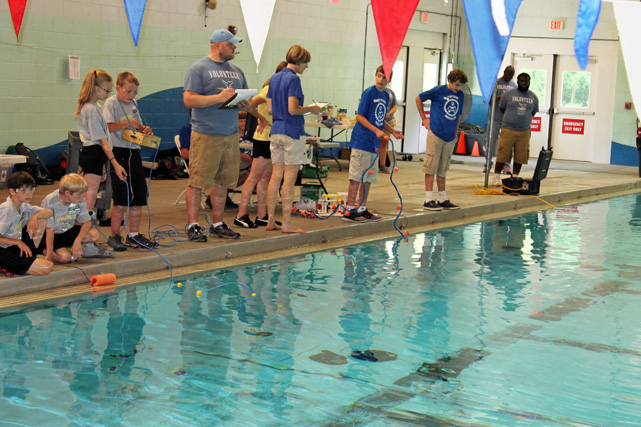
Sixteen student teams from middle, junior and high schools competed in the 2016 Gray’s Reef Southeast Regional MATE ROV Competition at the Chatham County Aquatic Center on April 30. After a full day of competition, seven-time regional champion Carrollton High School won the right to advance to the international round, held in June at the NASA Johnson Space Center Neutral Buoyancy Lab in Houston.

Carrollton High School, located west of Atlanta, has fielded strong teams that have placed as high as ninth in the global competition. Its team InnovOcean holds high hopes of taking home the top prize this year and will compete against students from various locations including Canada, Russia, Hong Kong and Scotland.

Beginning in 2004, Gray’s Reef National Marine Sanctuary partnered with the Marine Advanced Technology Education, or MATE, Center to offer underwater robotics as a vehicle to teach science, technology, engineering and math.

Two Atlanta area schools competing. Photo credit: Brian Greer

Two Atlanta area schools competing. Photo credit: Brian Greer

The ROV competition requires students to build tethered underwater robots — called remotely operated vehicles, or ROVs — from scratch, and then challenges them to perform tasks simulating real-world operations conducted by exploration organizations like NOAA’s National Marine Sanctuaries, NASA and other marine agencies worldwide. Teams are able to choose from four different classes of competition defined by skill level, instead of age, which further illustrates real-world circumstances. Only two classes — the Explorer and Ranger levels — are eligible to compete at the international competition.

In order to win, teams must not only build and successfully pilot an underwater robot, they have to create a company to market and sell their ROV. Students prepare posters, product spec sheets, safety procedures, design abstracts, business cards and presentations to working professionals who serve as contest judges.

Led by Jody Patterson, events coordinator at Gray’s Reef National Marine Sanctuary, staff and sanctuary volunteers organize the regional competition and create simulated workplace scenarios for the ROV pilots. This year’s regionals focused on “innerspace” ROV tasks, including recovering equipment, conducting forensic fingerprinting of oil spills, analyzing deep water studies of corals and capping wellheads of oil rigs.

The sanctuary’s Team Ocean volunteer divers worked all day with NOAA divers to continually set up the underwater task components. Other volunteers served as judges and safety inspectors.

“It is a privilege to host the Southeast Regional ROV competition each year,” said Gray’s Reef National Marine Sanctuary Superintendent Sarah Fangman. “To properly protect marine life and special areas like Gray’s Reef, we need tools to help us explore and understand the mysteries of the ocean. These students — future engineers and scientists — will create the next generation of instruments used at NOAA, NASA and the maritime industries.”

Death in the ocean keeps Skidaway Institute’s Harvey’s research alive

UGA Skidaway Institute of Oceanography scientist Elizabeth Harvey travels to the farthest reaches of the globe and in the nastiest weather to study microscopic marine plants known as phytoplankton. Last fall, Harvey spent a month on board a research ship in the turbulent North Atlantic as part of a NASA-funded project to learn more about these tiny organisms that are vital to life on the planet.

OLYMPUS DIGITAL CAMERAHarvey is one of UGA Skidaway Institute’s newest researchers, having joined the faculty in August of last year. Originally from Maine, she received her doctorate in oceanography from the University of Rhode Island and followed that with a position as a post-doctoral investigator at Woods Hole Oceanographic Institute. While she has a broad set of interests, phytoplankton have become the focus of her research.

“Phytoplankton are really important to a lot of different processes that impact life on Earth,” Harvey said. “They are at the bottom of the food chain so they are really important for feeding higher trophic levels like fish — and even higher — to whales really.”

Phytoplankton also play an important role in how nutrients and carbon are cycled around the world. It’s estimated that phytoplankton provide about 50 percent of the oxygen we breathe.

“So if you like breathing oxygen, you should like phytoplankton,” she said.

To study phytoplankton, she said, is to look into a world where lots of different interactions happen. Harvey’s work specifically focuses on the interactions between those single cell plants and the other organisms around them, including microzooplankton predators, bacteria and other phytoplankton. She hopes to better understand some of those individual interactions in order to make predictions on a larger scale.

“You wouldn’t think a single cell could be so dynamic, but phytoplankton are really complex,” Harvey said. “Rumor is NASA once took a look at one particular class of phytoplankton to see if they were extra-terrestrial.”

Using sensors on their cell surface, phytoplankton can sense their immediate surroundings — detecting organisms around them, sensing predators and modifying their behavior to escape predation. Some also produce toxic compounds in self-defense.

“Amazingly, they have very specific but very important interactions with other organisms,” she said. “You wouldn’t think a single cell could to that, but they do, and it can have some large-scale consequences.”

Last fall’s cruise on board the Woods Hole Research Vessel Atlantis was part of the NASA-sponsored North Atlantic Aerosols and Marine Ecosystems Study, or NAAMES. It was the first of a series of cruises to study an annual spring phytoplankton bloom in the North Atlantic. Harvey was one of 32 scientists on board. Her particular role was to measure phytoplankton mortality by both looking at the rate that phytoplankton were subject to predation or “grazing” by microzooplankton and also mortality due to viruses.

“I like to try to get people’s attention by telling them I am interested in death, which I sort of am,” Harvey said. “I am interested in how phytoplankton die.”

Understanding the relationship of phytoplankton mortality due to grazing compared to viral infections is important when trying to understand how carbon flows through marine ecosystems. The carbon from phytoplankton cells consumed by microzooplankton may continue to travel up the food web, while carbon from phytoplankton killed by viruses fuels the growth of other microbes, or could result in carbon sinking to the deep ocean.

Cruising the North Atlantic in November was no picnic. Harvey recalled 30-foot seas and 50-knot winds.

“That was a little adventurous,” she said. “We couldn’t do deck work. I didn’t tell my parents or husband about that.”

However, at 274 feet long and displacing more than 3,500 tons, the R/V Atlantis is a fairly large research ship, and Harvey says she never felt unsafe.

The days frequently started at 4 a.m. when scientists would lower an instrument package over the side to measure ocean conditions like salinity and temperature and to collect water samples. The scientists would work until eight or nine in the evening before catching some sleep and starting again the next morning.

“It’s a lot of long, hard work, but, on the other hand, your life becomes very simple,” she said. “The commitments in your normal life fade away. Someone even cooks your food for you every day.

“You work for long hours, but in the scheme of things, that is what you are there to do. There are no other distractions.”

Harvey says she was very happy to be part of the science team on the first cruise of the NAAMES project, and she enjoyed working with the other scientists on board.

“Everyone was very collegial and thrilled to be a part of a really cool project,” she said. “Scientists always like to get data, so sometimes I think that if I can be collecting new data, I am happy.”

Skidaway Institute’s Diaz studies the tiny organisms with a big impact

Like many oceanographers, Julia Diaz is difficult to categorize. Is she a biologist, or is she a chemist? The answer is — a little of both. Diaz’s research interests lie where biology and chemistry meet.

“My absolute favorite thing in the world is looking at phytoplankton under the microscope,” she said. “And I am also very passionate about chemistry.

OLYMPUS DIGITAL CAMERA“Our chemical environment really shapes our health and impacts our climate and all kinds of natural resources. So I am interested in the intersection of those two parts of nature — how tiny microscopic life interacts with the invisible chemistry out there to shape the environment in some pretty big ways.”

Diaz joined the faculty of UGA Skidaway Institute of Oceanography in fall 2015 as a homecoming of sorts. She was raised in Alpharetta just outside Atlanta. She graduated summa cum laude from the University of Georgia with a degree in biology and then went on to earn a Ph.D. in earth and atmospheric sciences from Georgia Tech. Her postdoctoral work took her to Harvard University and Woods Hole Oceanographic Institution.

Diaz targeted science as her future from an early age. Her father is a retired Georgia State University professor, and her entire family was involved in education. Her brother is an astrophysicist, and she jokes that they study opposite ends of the universe—with her specializing in the very small while he studies the very large.

“I grew up talking about science with my dad, my brother and my mom,” she said. “It was always on my mind, and I was pretty good at it. It felt good to learn and to always be exploring new things.”

As an undergrad at UGA, her interest in science grew into a passion.

“I got into some really cool classes, where we basically spent two days out of the week staring down a microscope at pond water and it was just the coolest thing,” she said. “All these creatures that you would never imagine are there. It’s amazing — this whole other world that really drew me in.”

In graduate school, Diaz focused more on chemistry to complement her background in biology.

“I originally got interested in marine chemistry and biology because I was inspired by the fact that, billions of years ago, marine microbes created oxygen and other life-giving chemicals to make this planet the habitable place that it is,” she said.

Diaz’s work has taken her from the Caribbean to Antarctica.

“One of the best parts about this job is that it lets you see the world. Antarctica was the most amazing experience — you never get tired of seeing penguins,” she said.

Diaz with her penguin friends

Diaz with her penguin friends

“Personally, I never got tired of looking at Antarctic phytoplankton, either. They can attach to the underside of sea ice, making it look like it’s been dipped in coffee, but under the microscope, it’s like peering inside a jewelry box of gorgeous single cells, so many ornate shapes and vibrant colors. It’s just magical.”

Many of Diaz’s projects focus on phytoplankton — microscopic plantlike organisms that drift with the ocean’s currents. They form the base of the marine food chain and produce half of the oxygen in the atmosphere. Among other projects, she studies how starving phytoplankton obtain the chemical nutrients they need from seawater, and she attempts to identify the enzymes that drive those biogeochemical processes.

Diaz is also interested in how phytoplankton convert chemical elements into forms that can be harmful or beneficial to life, such as reactive oxygen species, or ROS, types of oxygen with additional electrons. They are produced in all living things as a byproduct of metabolism.

“ROS can be toxic, but they can also be very beneficial to life,” Diaz said. “They can serve as cell signals that promote growth and immune defense. Our own white blood cells produce ROS as a defense mechanism against invading pathogens.”

An important facet her work seeks to understand is how phytoplankton may use ROS to survive stressful situations, such as attack by predators. These ROS-driven processes may play a role in the formation and decline of giant phytoplankton blooms so large they can be seen by satellites.

She admits her work can be challenging to communicate outside of her field, because much of the research cannot be seen by the naked eye. However, she said, those invisible chemical processes are occurring in the ocean over sizeable areas and long time periods, and they produce large visible effects that shape our daily lives.

“From starvation to cell defense, a lot of the work I do relates to stress in the oceans — how marine life copes with stressful conditions, how stress changes the chemistry of the oceans and ultimately how that changes the environment on a global scale. The oceans are under increasing amounts of stress due to climate change, pollution and other human impacts, so I think this kind of research has an important place in the understanding of our changing planet.”

###

Black gill stakeholders meeting set for June 22

As the 2016 Georgia shrimping season gets underway, the University of Georgia Marine Extension and Georgia Sea Grant, and the UGA Skidaway Institute of Oceanography will host a meeting to present the latest research and other information on black gill in Georgia and South Carolina shrimp. The meeting will be held at the UGA Marine Extension Aquarium at the north end of Skidaway Island in Savannah, Ga. on Wednesday, June 22, from 1-4 p.m.

Black gill is a condition affecting the coastal shrimp population. It is caused by a microscopic parasite. Many shrimpers believe black gill may be largely responsible for reduced shrimp harvests in recent years. UGA Skidaway Institute scientist Marc Frischer is leading a research project, now in its third year, into the causes and effects of black gill on the Georgia and South Carolina shrimp population.

A shrimp with the Black Gill condition clearly evident.

A shrimp with the Black Gill condition clearly evident.

The purpose of the meeting is to provide stakeholders, such as shrimpers, fish house owners, wholesalers or anyone else interested in black gill, with an update on black gill research efforts.  Frischer and South Carolina Department of Natural Resources scientist Amy Fowler and will present their latest research findings. UGA Marine Extension and the Georgia Department of Natural Resources will also provide updates. The meeting will be open to the public.

The meeting is for information purposes only. No management decisions will be made.

For additional information, contact Bryan Fluech, UGA Marine Extension, at (912) 264-7269.

What: Black Gill Stakeholders Meeting

When: Wednesday, June 22, 1-4: p.m.

Where: UGA  Aquarium, 30 Ocean Science Circle, Savannah, Ga., 31411

Directions: http://marex.uga.edu/visit_aquarium/

Gray’s Reef sponsors ‘A Fishy Affair’ to combat lionfish

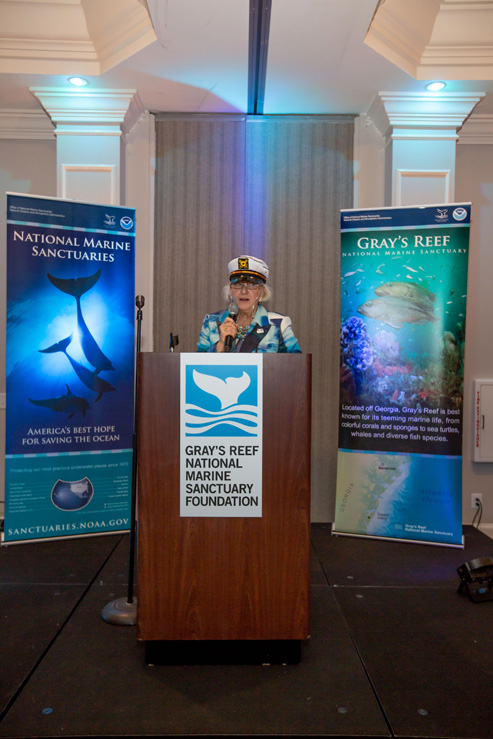
The Gray’s Reef National Marine Sanctuary Foundation hosted its first major fundraiser on Sept. 24 – “A Fishy Affair: Malicious but Delicious.” Four of Savannah’s prominent chefs cooked up their best lionfish dishes in an effort to encourage restaurants to put lionfish on their menus because they are invasive — but tasty – creatures. The event was sold out, and almost 250 people enjoyed the evening.

A Fishy Affair board member Kathryn Levitt.

A Fishy Affair board member Kathryn Levitt.

The lionfish is native to the tropical waters of the South Pacific and Indian Oceans. They are popular in home aquariums but are now invading ecosystems throughout the Atlantic coast and Caribbean. Lionfish damage the ocean by eating up to 20 small fish per day. With a very quick reproduction rate and no natural predators in Atlantic waters, they have multiplied quickly and threaten the natural biodiversity that provides economic and recreational opportunities. While completely removing lionfish from Atlantic and Caribbean waters is unlikely, reducing their numbers is critical to the ocean and for Gray’s Reef.

A Fishy Affair featured a full dinner, a short award-winning lionfish film, “Ocean Invaders,” by Mandee Malonee, a live Lionfish for viewing and a small live auction.  All proceeds benefit Gray’s Reef National Marine Sanctuary Foundation.

‘Modena’ strikes oil

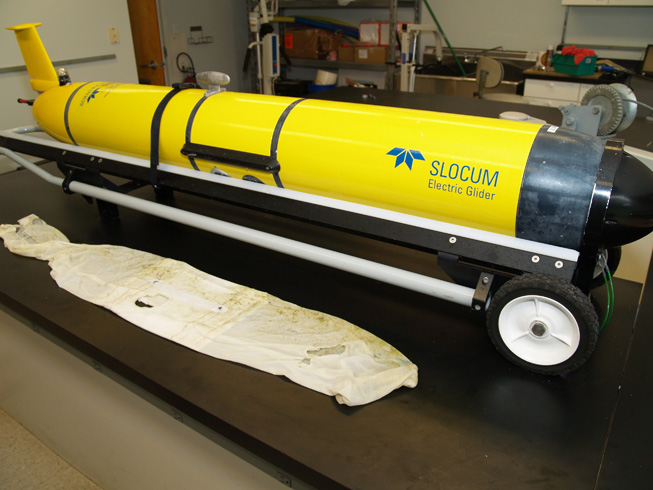
The UGA Skidaway Institute Autonomous Underwater Vehicle “Modena” found oil last summer, but not in the way anyone expected.

Modena was dispatched into the Gulf of Mexico as part of the ECOGIG (Ecosystem Impacts of Oil & Gas Inputs to the Gulf) research project to study the long-term effects of the Deepwater Horizon oil spill on the Gulf ecosystem. When the researchers, including Skidaway Institute scientist Catherine Edwards, recovered Modena, they discovered her fabric skin was covered with dark blotches. At first the team thought it was some sort of algae. Closer examination revealed the spots were created by oil droplets in the water.

Modena and  her oil-stained skin.

Modena and her oil-stained skin.

Oil stains on Modena's skin.

Oil stains on Modena’s skin.

Edwards and the team believe the oil stains were caused by droplets from the spill that have remained suspended in the water column.