Category Archives: skidaway institute

‘Modena’ strikes oil

The UGA Skidaway Institute Autonomous Underwater Vehicle “Modena” found oil last summer, but not in the way anyone expected.

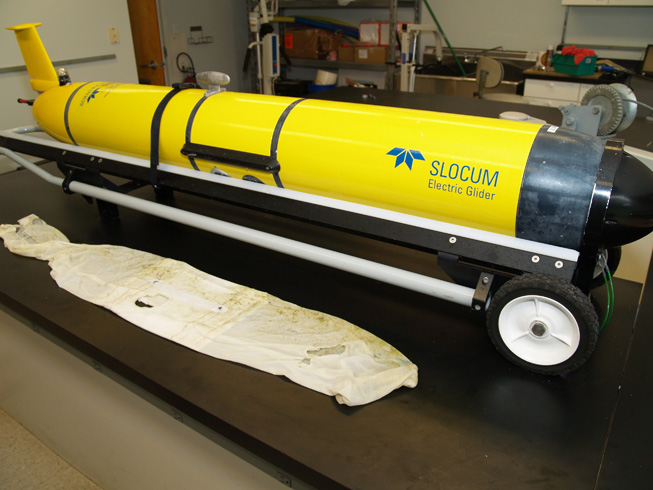
Modena was dispatched into the Gulf of Mexico as part of the ECOGIG (Ecosystem Impacts of Oil & Gas Inputs to the Gulf) research project to study the long-term effects of the Deepwater Horizon oil spill on the Gulf ecosystem. When the researchers, including Skidaway Institute scientist Catherine Edwards, recovered Modena, they discovered her fabric skin was covered with dark blotches. At first the team thought it was some sort of algae. Closer examination revealed the spots were created by oil droplets in the water.

Modena and  her oil-stained skin.

Modena and her oil-stained skin.

Oil stains on Modena's skin.

Oil stains on Modena’s skin.

Edwards and the team believe the oil stains were caused by droplets from the spill that have remained suspended in the water column.

UGA Skidaway Institute scientist stands atop the globe


UGA Skidaway Institute of Oceanography researcher Chris Marsay has stood on top of the world—literally.

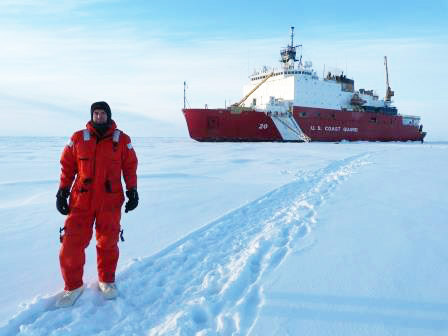
Marsay arrived at the North Pole in early September and took part in the U.S .GEOTRACES Arctic Expedition on board the U.S. Coast Guard Cutter Healy, a polar icebreaker.

Marsay at the North Pole in front of the U.S. Coast Guard Cutter Healy.

Marsay at the North Pole in front of the U.S. Coast Guard Cutter Healy.

The project is part of an international, multiple icebreaker effort to conduct geochemical sampling of the Arctic Ocean. The cruise arrived at 90 degrees north on Sept. 5 in what is the first occupation of the North Pole by an unaccompanied U.S. surface ship—submarines usually follow ships below the ice. While at the pole, the Healy rendezvoused with the German ship conducting the German leg of the GEOTRACES Arctic program.

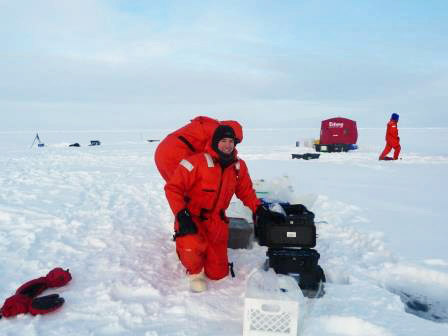
Marsay with his gear at the North Pole.

Marsay with his gear at the North Pole.

Marsay is working with UGA Skidaway Institute professor Cliff Buck and scientists from Florida State University and Rutgers University. The research team was funded by the National Science Foundation to collect samples from the atmosphere, precipitation and surface water from melt ponds during the cruise.

“Our research goals are to describe the chemistry of atmospheric deposition to the region and quantify flux rates,” Buck said. “These data will then be shared with the scientific community to better understand biogeochemical cycling of trace elements and isotopes in the Arctic Ocean.”

Diaz joins UGA Skidaway Institute faculty

Marine biogeochemist Julia Diaz has joined the faculty of the University of Georgia Skidaway Institute of Oceanography as an assistant professor.

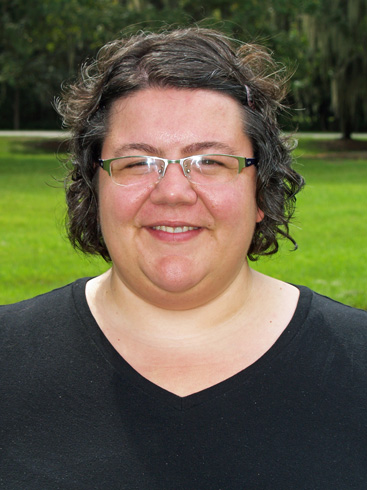
OLYMPUS DIGITAL CAMERAOriginally from Alpharetta, Ga., Diaz was graduated summa cum laude from the University of Georgia with a B.S. in biology and went on to earn her Ph.D. in earth and atmospheric sciences from Georgia Tech. She conducted postdoctoral research at Harvard University and the Woods Hole Oceanographic Institution.

Diaz’s research examines how the chemistry and microbiology of the oceans shape each other and, ultimately, how this interaction affects ecosystem health from local to global scales. She is currently studying the chemical basis of coral bleaching, a devastating consequence of global warming which threatens coral reefs worldwide.

“I also study how microscopic plantlike organisms acquire the chemical nutrients they need to survive in extremely nutrient-poor areas of the ocean and how these processes may affect ecosystem structure and climate,” she said. “My research has taken me all over the world, from Antarctica to the Caribbean, and now I am very excited to explore new scientific questions along our beautiful coast and offshore waters.”

Joint summer course draws notice

The joint summer course taught partially at Skidaway Institute has received some attention.

Taught by Jim Nelson and Dana Savidge at Skidaway, and Mary Ann Moran at Sapelo Island, the new program was the featured, cover story in the most recent issue of the University of Georgia Magazine. (Click the image to access the article.)

GM_Sept15 w

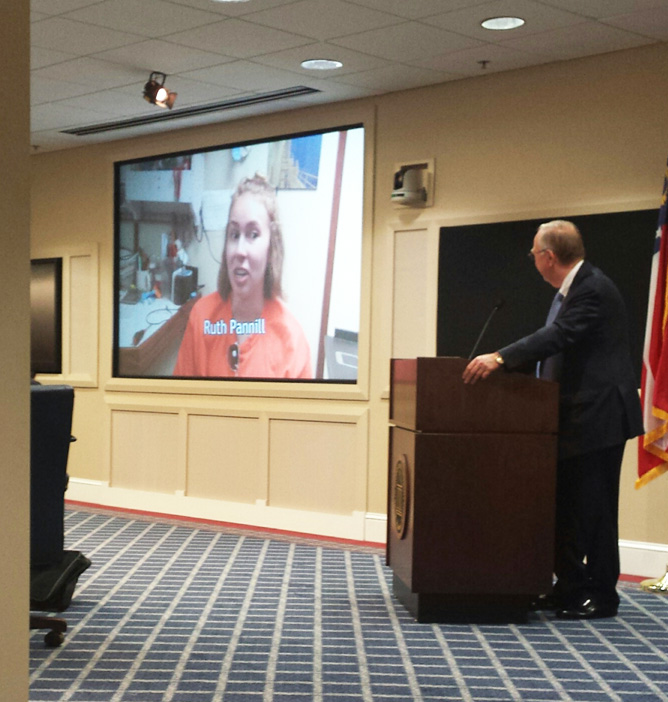
USG Chancellor Hank Huckaby featured a video produced on the project at the August Board of Regents meeting as part of his report to the board.

BOR Video w


Skidaway Institute participates in worldwide ocean snapshot

Scientists at the University of Georgia Skidaway Institute of Oceanography joined researchers around the globe in a worldwide Ocean Sampling Day on Sunday, June 21, the summer solstice.

This was the second year Skidaway researchers have participated in the Ocean Sampling Day event. The first was conducted last year, also on the summer solstice. The event focuses on simultaneous sampling of microbes in ocean, coastal and Great Lakes waters.

This year, 191 marine research locations—from the Rothera Research Station in Antarctica to Göteborg University in Sweden—participated. The sampling program supports international missions to provide

“It’s a global effort to take a snapshot of microbes across the world’s oceans at the same time, on the same day, in this case, the summer solstice,” said Skidaway Institute professor Marc Frischer.

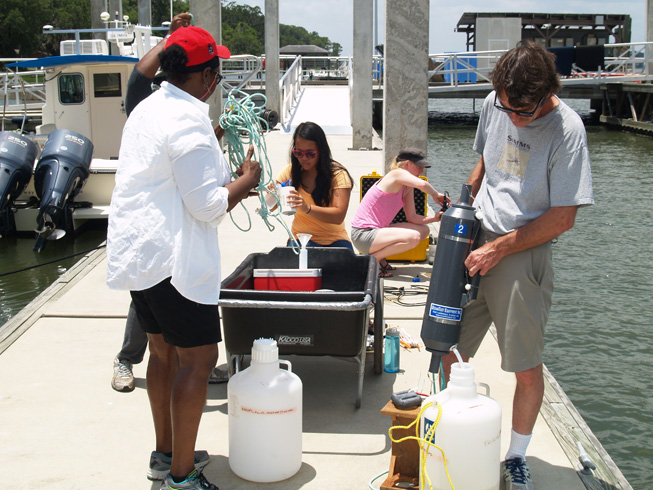
The Skidaway Institute team transfers a water sample from the Skidaway River during Ocean Sampling Day

The Skidaway Institute team transfers a water sample from the Skidaway River during Ocean Sampling Day

Frischer cited the significance of the project by describing microbes as the “engines of our planet” and said half the oxygen in the atmosphere is produced by microbes in the ocean.

Skidaway Institute scientists collected samples at two locations. One team collected and processed samples from the Skidaway River estuary immediately adjacent to the Skidaway Institute campus. That also served as part of an ongoing water-quality monitoring program Skidaway Institute has supported for more than 25 years. A second group teamed up with scientists from the National Oceanic and Atmospheric Administration Gray’s Reef National Marine Sanctuary and collected samples from Gray’s Reef. The 14,000-acre marine sanctuary is located about 17 miles off the Sapelo Island coast.

“We helped Gray’s Reef by collecting and processing their samples in the way they needed to be done,” Frischer said. “You really need a laboratory for that, and we were able to provide that.”

One goal of the global project is to note the commonalities and the differences among the microbial communities around the globe. Some of those differences were seen just in the samples collected at Gray’s Reef and at the Skidaway campus, two sites only 40 miles apart.

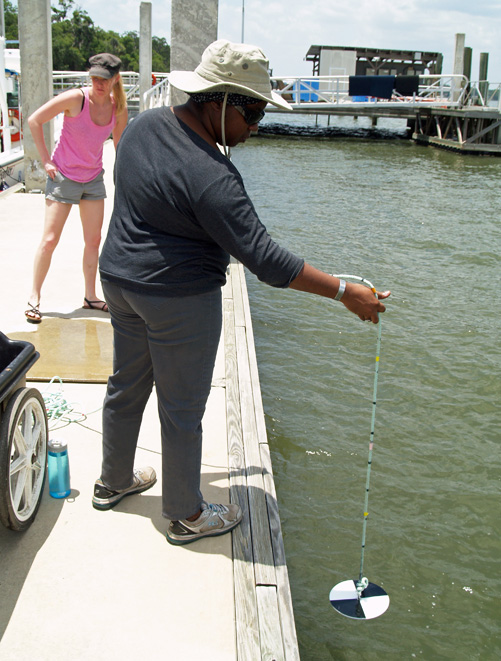
Grad student LaGina Frazier lowers a disc used to measure turbidity into the water off the UGA Skidaway Institute dock.

Grad student LaGina Frazier lowers a sensor into the water off the UGA Skidaway Institute dock.

“We generally observe a larger number of smaller organisms out in the ocean, which makes sense because they are adapting to a system with lower nutrients,” Frischer said. “We also saw a different kind of photosynthetic organisms since there is much more light available in the ocean compared to rather turbid waters in our estuary.”

Much of the fieldwork at both Skidaway Institute and Gray’s Reef was handled by undergraduate college students gaining research experience at Skidaway Institute this summer. These included students from UGA and Savannah State University’s Research Experience for Undergraduates program.

All samples and data were sent to Bremen, Germany, for DNA extraction and sequencing to ensure maximum comparability. The resulting data will be made publicly available as soon as quality checks are finished. These cumulative samples, related in time, space and environmental parameters, will provide insights into fundamental rules describing microbial diversity and function and contribute to the blue, or oceanic, economy through the identification of novel, ocean-derived biotechnologies.

Ocean Sampling Day was jointly coordinated by Jacobs University in Bremen, Germany, and the University of Oxford in the U.K. and is part of the European Union-funded Ocean of Tomorrow research project Micro B3.

“It is really important to have a global perspective,” Frischer said. “We are glad we can participate in what they are now calling “gigascience” where we are collecting a snapshot from all over the world. It is amazing!”

Additional information on the global Ocean Sampling Day project is available at www.microb3.eu/osd.

A video of Ocean Sampling Day is available on the Skidaway Institute YouTube Channel at:

https://www.youtube.com/watch?v=5c8JuzvLUH8

Harvey joins Skidaway Institute faculty

OLYMPUS DIGITAL CAMERA

Biological oceanographer Elizabeth Harvey has joined the faculty of the UGA Skidaway Institute of Oceanography as an assistant professor.

Harvey received her bachelor’s degree in marine science from the University of Maine and a master’s in environmental science from Western Washington University. She earned her doctorate in oceanography from the University of Rhode Island. Immediately prior to joining Skidaway Institute, she completed a post-doctoral fellowship at Woods Hole Oceanographic Institution.

Harvey’s research focus is on the mechanisms of mortality in the planktonic environment in the ocean and how that influences food web structure and biogeochemical cycling.

UGA Skidaway Institute produces informational video on black gill in Georgia shrimp

The UGA Skidaway Institute of Oceanography has produced an informational video to educate the public about black gill, a condition affecting Georgia shrimp, and the institute’s research into the problem.

Black gill is a mysterious condition affecting shrimp from Florida to North Carolina. A number of shrimpers have blamed black gill for their reduced harvests.

Almost nothing was known of the condition until the UGA Skidaway Institute began looking into the issue in early 2014. Since then, researchers have learned much about the condition, but much is still unknown. This video provides background on the condition and the results of the investigation thus far.

The video can be viewed below or accessed through the UGA Skidaway Institute Web site at http://www.skio.uga.edu.

The black gill research is funded by Georgia Sea Grant. The video was produced in cooperation with UGA Marine Extension, the university’s Office of Public Service and Outreach, Georgia Sea Grant and the Georgia Department of Natural Resources.

Scientists work to predict 22nd century look of the Georgia coast

The Georgia coast is characterized by a complex system of barrier islands, salt marshes, estuaries, tidal creeks and rivers. As the sea level rises over the next century, that picture will change. UGA Skidaway Institute of Oceanography scientist Clark Alexander is working on a project to predict how the coast may look 25, 50 and 100 years from now.

Predictions of sea level rise over the next century vary from the current rate of roughly 30 centimeters—about a foot—to as much as two meters—about 6 feet. Although scientists disagree on the ultimate height of the rise, they all agree that salty water is moving inland and will continue to do so for the foreseeable future, Alexander said. Here on the Georgia coast, islands will become smaller or disappear entirely; salt marshes will be inundated by the rising waters and migrate toward the uplands; and some low-lying uplands will become salt marshes.

To predict the extent of these changes, scientists are using the predictive Sea Level Affecting Marshes Model, or SLAMM, which was originally developed for the U.S. Fish and Wildlife Service.

SLAMM predicts the effects of future sea level rise based on two key inputs: an elevation mapping of the coastal zone and salinity profiles up the rivers and waterways. Salinity and elevation are two key factors that determine the type of plants, and thus habitat, that will be present at any particular location.

“As the sea level rises, the fresh water in rivers will be pushed further upstream,” Alexander said. “The brackish and salty water will also move up, and the salt marshes will expand.”

Funded by a Coastal Incentive Grant from the Georgia Department of Natural Resources Coastal Management Program, Alexander and his team have been studying the five key river systems along the coast and numerous salt marsh estuaries. Salinity along the coast is dominantly affected by river discharge into the estuaries, so the team has been conducting its surveys during both winter—high river flow—and the summer—low river flow—conditions.

“We start at the mouth of a river about an hour before high tide and then we follow that high tide up the river, mapping the surface salinity along the way,” Alexander said. “We find the maximum inshore intrusion of salinity at high tide during a spring tide. That is the location that defines the boundary between the brackish marshes and the freshwater marshes.”

Researcher Mike Robinson prepares the adjusts the salinity sensors, while fellow researcher LeeAnn DeLeo drives the boat.

Researcher Mike Robinson prepares the adjusts the salinity sensors, while fellow researcher LeeAnn DeLeo drives the boat.

In addition to tracking surface salinity, the researchers also stop periodically and measure the salinity throughout the water column to determine if what they measure at the surface is similar to what is present near the bottom. They lower a device that measures the water conductivity (which is related to salinity), temperature and depth from the surface to the bottom. Also equipped with GPS capability, the device automatically captures the location of every water column profile.

Researcher LeeAnn DeLeo lowers a CTD monitor through the water column.

Researcher LeeAnn DeLeo lowers a CTD monitor through the water column.

In many coastal regions, denser, saltier water tends to sink to the bottom and the lighter, fresher water remains near the surface. However, because of the energy produced by Georgia’s wide tidal range, the team found that most of the water on the Georgia coast is well mixed and doesn’t show up as layers.

The second part of the project is to fine-tune existing elevation data. Scientists have an extensive set of elevation information from airplane-mounted Light Detection And Ranging systems. LIDAR is usually very accurate, except in marshes, because it cannot see through the vegetation to the actual ground surface.

“You might be off by 30 centimeters or more, and in a low-lying, flat area like our coastal zone, that can make a big difference in predicting where the water will flood,” Alexander said.

The Skidaway Institute team is working with Georgia Southern University scientist Christine Hladik on a fix. By comparing LIDAR data with the true elevation in a particular area, Hladik observed that the LIDAR error varied according to the type of plants growing there. For example, if the area contained the dense, tall spartina, the error was large and, on average, a consistent number of centimeters. If the region was covered with a different, less-dense-growing salt marsh plant, like short spartina, the error was smaller but also consistent.

“She discovered that if you know what type of vegetation is covering a section of marshland, you can plug in the correction and come back with an accurate measure of the elevation,” Alexander said.

The research team observed the vegetation and measured the true ground level at 400 randomly selected points throughout coastal brackish and salt marshes in Georgia. That information and knowledge of plant types is being used to correct the existing marsh elevations.

The research team will complete one more set of river surveys before the project ends in September. Alexander hopes to obtain continued funding to use this newly acquired elevation and salinity data in a fresh SLAMM model run for the Georgia coast, using all the high-resolution data developed in this project.

“We should be able to look out as much as 100 years in the future and see where the different wetlands will be by then,” he said. “That way we can plan for marsh sustainability, retreat and sea level rise.”

Skidaway Marine Science Day to feature Georgia’s first oyster hatchery

A close-up look at Georgia’s first oyster hatchery will be one of the featured attractions at Skidaway Marine Science Day on Saturday, Oct. 24. The campus-wide open house will be held from noon to 4 p.m. on the University of Georgia’s Skidaway Island campus, located on the north end of the island.

The oyster research team will provide behind-the-scenes tours of the new hatchery, which is a project of the UGA Marine Extension’s Shellfish Laboratory and Georgia Sea Grant, units of UGA Public Service and Outreach. It is hoped the oyster hatchery will make the Georgia oyster industry more durable, contribute to aquaculture diversification and elevate one of Georgia’s best-kept culinary secrets from the backyard roast to the tables of the finest restaurants from Savannah to Atlanta and beyond.

The hatchery tour is just one feature of a lengthy program of activities, displays and tours making the annual event one that attracts thousands of visitors each year.

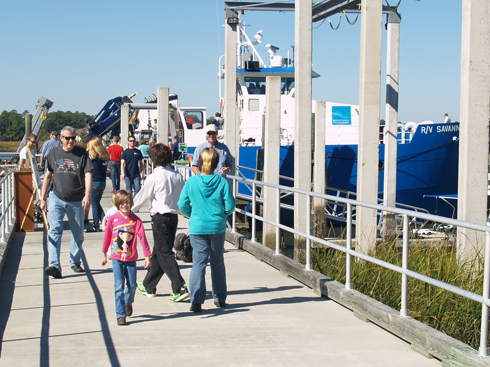
The UGA Skidaway Institute of Oceanography’s 92-foot ocean-going Research Vessel Savannah will be open for tours and will exhibit science displays.

Tour the Skidaway Institute’s ocean-going Research Vessel Savannah.

Tour the Skidaway Institute’s ocean-going Research Vessel Savannah.

Elsewhere on campus, Skidaway Institute will present a variety of marine science exhibits and hands-on science activities, including the ever-popular Microbe Hunt and Plankton Sink-Off. Skidaway Institute scientists will present a series of short, informal talks and question-and-answer sessions on current scientific and environmental issues.

The UGA Aquarium, operated by UGA Marine Extension, will be open to visitors with no admission fee. Aquarium educators will offer visitors an afternoon full of activities including a hands-on reptile exhibit, behind-the-scenes peeks of the aquarium, fish feedings and microscope investigations.

The Reptile Experience fascinates nature lovers of all ages.

The Reptile Experience fascinates nature lovers of all ages.

A brand new touch tank exhibit will allow guests of all ages to get up close and personal with common coastal invertebrates.

Touch tanks allow visitors to experience sea creatures   up close.

Touch tanks allow visitors to experience sea creatures up close.

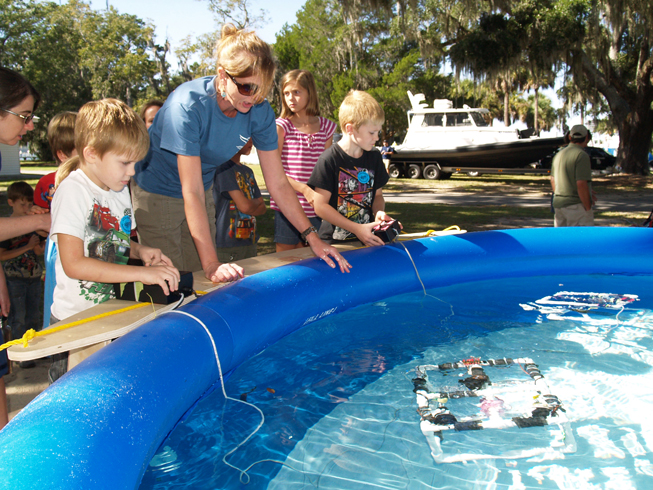
Gray’s Reef National Marine Sanctuary will offer visitors the experience of using the tools of the trade. They can explore an underwater reef with a remotely operated vehicle and find out how youth can participate in Savannah’s own MATE ROV competition. ROVs are underwater robots used on NOAA research vessels worldwide and are crucial for data collection in marine environments.

"Fly" an underwater ROV with Gray's Reef.

“Fly” an underwater ROV with Gray’s Reef.

A photo booth will allow visitors to visualize themselves SCUBA diving at Gray’s Reef or in other exotic settingsand will be able to post their pictures on social media.

Along with the campus organizations, Skidaway Marine Science Day will also include displays, demonstrations and activities from a wide range of science, environmental and education groups, such as The Dolphin Project, the Georgia Sea Turtle Center and The Nature Conservancy. Georgia Power will be on hand to provide information on the upcoming wind turbine project planned for the Skidaway Institute campus.

All activities at Skidaway Marine Science Day are free. For additional information, call 912-598-2325, or see http://www.skio.uga.edu.

UGA Skidaway Institute scientist shares Gulf oil spill research grant

UGA Skidaway Institute of Oceanography scientist Catherine Edwards is part of a research team that has received an $18.8 million grant to continue studies of natural oil seeps and track the impacts of the BP/Deepwater Horizon oil spill in the Gulf of Mexico ecosystem.

A satellite view of the Deepwater Horizon oil spill

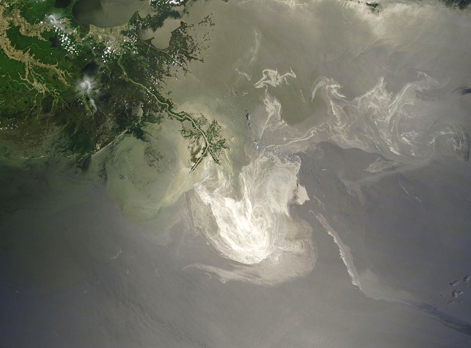
A satellite view of the Deepwater Horizon oil spill

Known as ECOGIG-2 or “Ecosystem Impacts of Oil and Gas Inputs to the Gulf,” the project is a collaborative, multi-institutional effort involving biological, chemical, geological and chemical oceanographers led by the University of Georgia’s Samantha Joye. The research team has worked in the Gulf since the weeks following the 2010 Macondo well blowout.

The three-year, $18.8 million ECOGIG-2 program was funded by the Gulf of Mexico Research Initiative, or GoMRI.

“Our goal is to better understand the processes that have affected the oil spill since 2010,” Edwards said. “How the droplets were dispersed? Where the oil went? How it was taken up by small microbes and also the effects on animals further up the food chain?”

Edwards’ role in the project is to use autonomous underwater vehicles, also called “gliders,” to collect data on conditions around the spill site. Equipped with sensors to measure characteristics such as depth, water temperature, salinity and density, the gliders can cruise the submarine environment for weeks at a time, collecting data and transmitting it back to a ship or a shore station.

Skidaway Institute scientist Catherine Edwards adjusts a glider’s buoyancy with graduate students Sungjin Cho and Dongsik Chan.

Skidaway Institute scientist Catherine Edwards adjusts a glider’s buoyancy with graduate students Sungjin Cho and Dongsik Chan.

“We want to understand the ocean currents—how they change over time and how they change in depth,” Edwards said. “Surface measurements give us a two-dimensional picture of the ocean. Glider data in the vertical provides more valuable information for more fully understanding ocean currents and how they arise.”

The gliders will operate in conjunction with shipboard instruments and also independently. One advantage of using the gliders is they can operate during storms and rough weather, when it may not be possible to use ships. Edwards said shipboard work doesn’t always give a full picture of ocean dynamics simply by the fact that they can only go out when the weather is reasonably clear.

When working in conjunction with research ships, the gliders can provide additional observations, significantly improving the quality of the data set. The gliders also report dissolved oxygen concentrations and optical measurements of chlorophyll and organic matter, and may also be used as a test vehicle for new instruments in development.

Edwards will use “GENIoS,” a new software package, to help navigate the gliders. GENIoS uses high-resolution forecast models of wind and ocean currents, along with information from the glider itself, to calculate the optimal path for the gliders. This will improve the quality of the scientific data collected.

GENIoS is a collaboration among Edwards, Fumin Zhang from the Georgia Institute of Technology and their two Georgia Tech Ph.D. students, Dongsik Chang and Sungjin Cho. GENIos has been tested for more than 210 glider-days on the continental shelf off Georgia and South Carolina. This experiment will be its first test in the Gulf of Mexico.

Edwards also hopes to use this project to test the gliders as platforms for new, experimental sensors developed by other members of the ECOGIG-2 team.

Others involved in ECOGIG-2 include UGA marine sciences faculty Christof Meile, Renato Castelao and Catherine Edwards as well as Annalisa Bracco and Joe Montoya of Georgia Tech.

For additional information, contact Catherine Edwards at (912) 598-2471 or catherine.edwards@skio.uga.edu.