Tag Archives: oceanography

UGA Skidaway Institute scientists study dynamic Cape Hatteras waters

Sometimes called the “graveyard of the Atlantic” because of the large number of shipwrecks there, the waters off of Cape Hatteras on the North Carolina coast are some of the least understood on the U.S. eastern seaboard. University of Georgia Skidaway Institute of Oceanography scientist Dana Savidge is leading a team, which also includes UGA Skidaway Institute scientist Catherine Edwards, to investigate the dynamic forces that characterize those waters.

The four-year project, informally called PEACH: Processes driving Exchange at Cape Hatteras, is funded by $5 million grant from the National Science Foundation. Skidaway Institute will receive $1.2 million for its part.
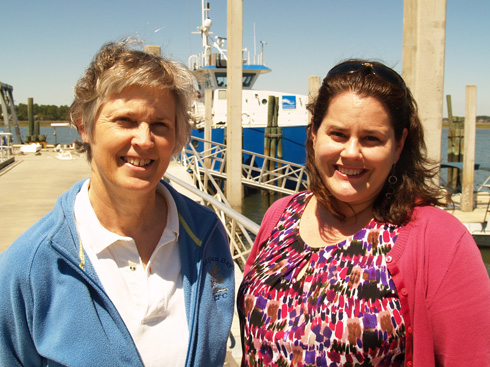
Researchers Dana Savidge (left) and Catherine Edwards

Researchers Dana Savidge (left) and Catherine Edwards

Two opposing deep ocean currents collide at Cape Hatteras, making the Atlantic Ocean near there highly dynamic. The warm Gulf Stream hugs the edge of the continental shelf as it flows north from the tip of Florida.  At Cape Hatteras, it opposes a colder current, the Slope Sea Gyre current, that moves southward along the mid-Atlantic coast and breaks away from the coast toward northern Europe. As in the deep ocean, the cool shelf waters of the mid-Atlantic continental shelf meet the warm salty shelf waters from the south at Cape Hatteras.

The convergence of all of these currents at one place means that, after long lifetimes in the sunlit shallow shelves, these waters may export large quantities of organic carbon—small plants and animals that have grown up on the shelf—to the open ocean. Scientists have little understanding of the details of how that happens and how it is controlled by the high-energy winds, waves and interaction the between the constantly changing Gulf Stream and Slope Sea Gyre currents.

According to Savidge, the area is very difficult to observe because the water is shallow, the sea-state can be challenging and the convergence of strong currents at one place make it hard to capture features of interest.

“It’s difficult to get enough instruments in the water because conditions change rapidly over short distances, and it’s hard to keep them there because conditions are rough,” she said. “Ships work nicely for many of these measurements, but frequently, the ships get chased to shore because of bad weather.”

To overcome the limitations of ship-based work, the research team will use a combination of both shore- and ocean-based instruments to record the movement and characteristics of the streams of water. A system of high-frequency radar stations will monitor surface currents on the continental shelf all the way out to the shoreward edge of the Gulf Stream, providing real-time maps of surface currents.

“Measuring surface currents remotely with the radars is a real advantage here,” Savidge said. “They cover regions that are too shallow for mobile vehicles like ships to operate while providing detailed information over areas where circulation can change quite dramatically over short times and distances.”

Edwards will lead a robotic observational component in which pairs of autonomous underwater vehicles called gliders will patrol the shelf to the north and south of Cape Hatteras.  Packed with instruments to measure temperature, salinity, dissolved oxygen and bio-optical properties of the ocean, both shelf- and deep-water gliders fly untethered through the submarine environment, sending their data to shore at regular intervals via satellite.

To compensate for the notoriously difficult conditions, Edwards will take advantage of a novel glider navigation system she developed with students and collaborators at Georgia Tech that automatically adjusts the glider mission based on ocean forecasts as well as data collected in real time.

“Our experiments show that we can keep the gliders where they need to be to collect the data we need,” she said. “The best part is that we get to put the maps of surface currents together with the subsurface information from the gliders, and we can make all of this information available in real time to scientists, fishermen and the general public.”

The researchers will also place a number of moorings and upward-pointing echo sounders on the sea floor. These acoustic units will track the water movement while also recording temperature and density.  PEACH will focus primarily on the physics of the ocean, but the information the researchers gather will also help scientists more fully understand the chemistry and biology, and may cast light on issues like carbon cycling and global climate change.

“Everyone is interested in the global carbon budget, and the effect of the coastal seas on that budget is not well understood,” Savidge said. “For example, many scientists consider the continental shelf to be a sink for carbon, because there is a lot of biology going on and it draws in carbon.

“However, there are indications that the shelf south of Hatteras is both a sink and a source of carbon. This project may help clarify that picture.”

The project will run through March 2020. The remaining members of the research team are Harvey Seim and John Bane of the University of North Carolina; Ruoying He of North Carolina State University; and Robert Todd, Magdalena Andres and Glen Gawarkiewicz from Woods Hole Oceanographic Institute.
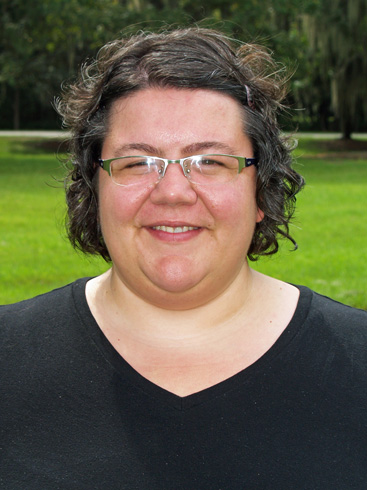
Death in the ocean keeps Skidaway Institute’s Harvey’s research alive

UGA Skidaway Institute of Oceanography scientist Elizabeth Harvey travels to the farthest reaches of the globe and in the nastiest weather to study microscopic marine plants known as phytoplankton. Last fall, Harvey spent a month on board a research ship in the turbulent North Atlantic as part of a NASA-funded project to learn more about these tiny organisms that are vital to life on the planet.

OLYMPUS DIGITAL CAMERAHarvey is one of UGA Skidaway Institute’s newest researchers, having joined the faculty in August of last year. Originally from Maine, she received her doctorate in oceanography from the University of Rhode Island and followed that with a position as a post-doctoral investigator at Woods Hole Oceanographic Institute. While she has a broad set of interests, phytoplankton have become the focus of her research.
“Phytoplankton are really important to a lot of different processes that impact life on Earth,” Harvey said. “They are at the bottom of the food chain so they are really important for feeding higher trophic levels like fish — and even higher — to whales really.”

Phytoplankton also play an important role in how nutrients and carbon are cycled around the world. It’s estimated that phytoplankton provide about 50 percent of the oxygen we breathe.

“So if you like breathing oxygen, you should like phytoplankton,” she said.

To study phytoplankton, she said, is to look into a world where lots of different interactions happen. Harvey’s work specifically focuses on the interactions between those single cell plants and the other organisms around them, including microzooplankton predators, bacteria and other phytoplankton. She hopes to better understand some of those individual interactions in order to make predictions on a larger scale.

“You wouldn’t think a single cell could be so dynamic, but phytoplankton are really complex,” Harvey said. “Rumor is NASA once took a look at one particular class of phytoplankton to see if they were extra-terrestrial.”

Using sensors on their cell surface, phytoplankton can sense their immediate surroundings — detecting organisms around them, sensing predators and modifying their behavior to escape predation. Some also produce toxic compounds in self-defense.

“Amazingly, they have very specific but very important interactions with other organisms,” she said. “You wouldn’t think a single cell could to that, but they do, and it can have some large-scale consequences.”

Last fall’s cruise on board the Woods Hole Research Vessel Atlantis was part of the NASA-sponsored North Atlantic Aerosols and Marine Ecosystems Study, or NAAMES. It was the first of a series of cruises to study an annual spring phytoplankton bloom in the North Atlantic. Harvey was one of 32 scientists on board. Her particular role was to measure phytoplankton mortality by both looking at the rate that phytoplankton were subject to predation or “grazing” by microzooplankton and also mortality due to viruses.

“I like to try to get people’s attention by telling them I am interested in death, which I sort of am,” Harvey said. “I am interested in how phytoplankton die.”

Understanding the relationship of phytoplankton mortality due to grazing compared to viral infections is important when trying to understand how carbon flows through marine ecosystems. The carbon from phytoplankton cells consumed by microzooplankton may continue to travel up the food web, while carbon from phytoplankton killed by viruses fuels the growth of other microbes, or could result in carbon sinking to the deep ocean.

Cruising the North Atlantic in November was no picnic. Harvey recalled 30-foot seas and 50-knot winds.

“That was a little adventurous,” she said. “We couldn’t do deck work. I didn’t tell my parents or husband about that.”

However, at 274 feet long and displacing more than 3,500 tons, the R/V Atlantis is a fairly large research ship, and Harvey says she never felt unsafe.

The days frequently started at 4 a.m. when scientists would lower an instrument package over the side to measure ocean conditions like salinity and temperature and to collect water samples. The scientists would work until eight or nine in the evening before catching some sleep and starting again the next morning.

“It’s a lot of long, hard work, but, on the other hand, your life becomes very simple,” she said. “The commitments in your normal life fade away. Someone even cooks your food for you every day.

“You work for long hours, but in the scheme of things, that is what you are there to do. There are no other distractions.”

Harvey says she was very happy to be part of the science team on the first cruise of the NAAMES project, and she enjoyed working with the other scientists on board.

“Everyone was very collegial and thrilled to be a part of a really cool project,” she said. “Scientists always like to get data, so sometimes I think that if I can be collecting new data, I am happy.”

Skidaway Institute’s Diaz studies the tiny organisms with a big impact

Like many oceanographers, Julia Diaz is difficult to categorize. Is she a biologist, or is she a chemist? The answer is — a little of both. Diaz’s research interests lie where biology and chemistry meet.

“My absolute favorite thing in the world is looking at phytoplankton under the microscope,” she said. “And I am also very passionate about chemistry.

OLYMPUS DIGITAL CAMERA“Our chemical environment really shapes our health and impacts our climate and all kinds of natural resources. So I am interested in the intersection of those two parts of nature — how tiny microscopic life interacts with the invisible chemistry out there to shape the environment in some pretty big ways.”

Diaz joined the faculty of UGA Skidaway Institute of Oceanography in fall 2015 as a homecoming of sorts. She was raised in Alpharetta just outside Atlanta. She graduated summa cum laude from the University of Georgia with a degree in biology and then went on to earn a Ph.D. in earth and atmospheric sciences from Georgia Tech. Her postdoctoral work took her to Harvard University and Woods Hole Oceanographic Institution.

Diaz targeted science as her future from an early age. Her father is a retired Georgia State University professor, and her entire family was involved in education. Her brother is an astrophysicist, and she jokes that they study opposite ends of the universe—with her specializing in the very small while he studies the very large.

“I grew up talking about science with my dad, my brother and my mom,” she said. “It was always on my mind, and I was pretty good at it. It felt good to learn and to always be exploring new things.”

As an undergrad at UGA, her interest in science grew into a passion.

“I got into some really cool classes, where we basically spent two days out of the week staring down a microscope at pond water and it was just the coolest thing,” she said. “All these creatures that you would never imagine are there. It’s amazing — this whole other world that really drew me in.”

In graduate school, Diaz focused more on chemistry to complement her background in biology.

“I originally got interested in marine chemistry and biology because I was inspired by the fact that, billions of years ago, marine microbes created oxygen and other life-giving chemicals to make this planet the habitable place that it is,” she said.

Diaz’s work has taken her from the Caribbean to Antarctica.

“One of the best parts about this job is that it lets you see the world. Antarctica was the most amazing experience — you never get tired of seeing penguins,” she said.

Diaz with her penguin friends

Diaz with her penguin friends

“Personally, I never got tired of looking at Antarctic phytoplankton, either. They can attach to the underside of sea ice, making it look like it’s been dipped in coffee, but under the microscope, it’s like peering inside a jewelry box of gorgeous single cells, so many ornate shapes and vibrant colors. It’s just magical.”

Many of Diaz’s projects focus on phytoplankton — microscopic plantlike organisms that drift with the ocean’s currents. They form the base of the marine food chain and produce half of the oxygen in the atmosphere. Among other projects, she studies how starving phytoplankton obtain the chemical nutrients they need from seawater, and she attempts to identify the enzymes that drive those biogeochemical processes.

Diaz is also interested in how phytoplankton convert chemical elements into forms that can be harmful or beneficial to life, such as reactive oxygen species, or ROS, types of oxygen with additional electrons. They are produced in all living things as a byproduct of metabolism.

“ROS can be toxic, but they can also be very beneficial to life,” Diaz said. “They can serve as cell signals that promote growth and immune defense. Our own white blood cells produce ROS as a defense mechanism against invading pathogens.”

An important facet her work seeks to understand is how phytoplankton may use ROS to survive stressful situations, such as attack by predators. These ROS-driven processes may play a role in the formation and decline of giant phytoplankton blooms so large they can be seen by satellites.

She admits her work can be challenging to communicate outside of her field, because much of the research cannot be seen by the naked eye. However, she said, those invisible chemical processes are occurring in the ocean over sizeable areas and long time periods, and they produce large visible effects that shape our daily lives.

“From starvation to cell defense, a lot of the work I do relates to stress in the oceans — how marine life copes with stressful conditions, how stress changes the chemistry of the oceans and ultimately how that changes the environment on a global scale. The oceans are under increasing amounts of stress due to climate change, pollution and other human impacts, so I think this kind of research has an important place in the understanding of our changing planet.”

###

‘Modena’ strikes oil

The UGA Skidaway Institute Autonomous Underwater Vehicle “Modena” found oil last summer, but not in the way anyone expected.

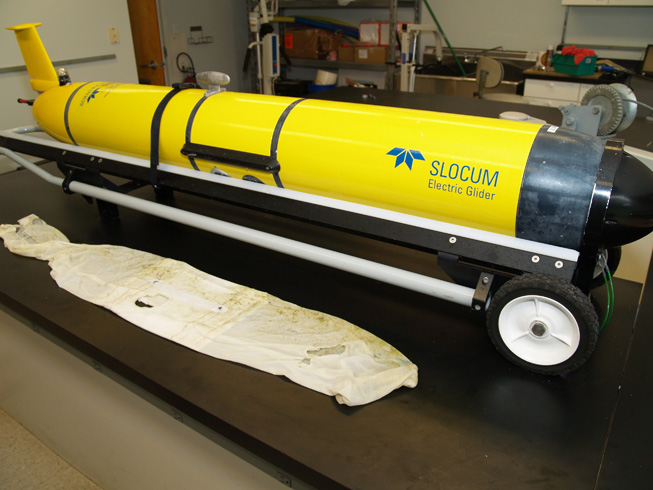
Modena was dispatched into the Gulf of Mexico as part of the ECOGIG (Ecosystem Impacts of Oil & Gas Inputs to the Gulf) research project to study the long-term effects of the Deepwater Horizon oil spill on the Gulf ecosystem. When the researchers, including Skidaway Institute scientist Catherine Edwards, recovered Modena, they discovered her fabric skin was covered with dark blotches. At first the team thought it was some sort of algae. Closer examination revealed the spots were created by oil droplets in the water.

Modena and  her oil-stained skin.

Modena and her oil-stained skin.

Oil stains on Modena's skin.

Oil stains on Modena’s skin.

Edwards and the team believe the oil stains were caused by droplets from the spill that have remained suspended in the water column.

UGA Skidaway Institute scientist stands atop the globe


UGA Skidaway Institute of Oceanography researcher Chris Marsay has stood on top of the world—literally.

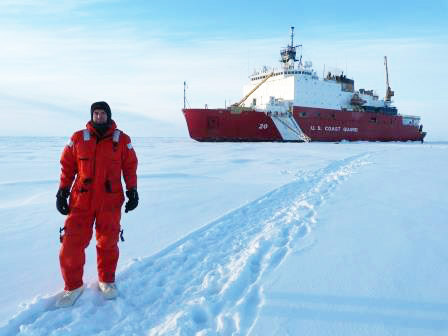
Marsay arrived at the North Pole in early September and took part in the U.S .GEOTRACES Arctic Expedition on board the U.S. Coast Guard Cutter Healy, a polar icebreaker.

Marsay at the North Pole in front of the U.S. Coast Guard Cutter Healy.

Marsay at the North Pole in front of the U.S. Coast Guard Cutter Healy.

The project is part of an international, multiple icebreaker effort to conduct geochemical sampling of the Arctic Ocean. The cruise arrived at 90 degrees north on Sept. 5 in what is the first occupation of the North Pole by an unaccompanied U.S. surface ship—submarines usually follow ships below the ice. While at the pole, the Healy rendezvoused with the German ship conducting the German leg of the GEOTRACES Arctic program.

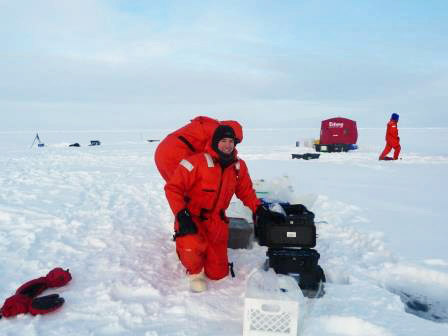
Marsay with his gear at the North Pole.

Marsay with his gear at the North Pole.

Marsay is working with UGA Skidaway Institute professor Cliff Buck and scientists from Florida State University and Rutgers University. The research team was funded by the National Science Foundation to collect samples from the atmosphere, precipitation and surface water from melt ponds during the cruise.

“Our research goals are to describe the chemistry of atmospheric deposition to the region and quantify flux rates,” Buck said. “These data will then be shared with the scientific community to better understand biogeochemical cycling of trace elements and isotopes in the Arctic Ocean.”

UGA Skidaway Institute scientist shares Gulf oil spill research grant

UGA Skidaway Institute of Oceanography scientist Catherine Edwards is part of a research team that has received an $18.8 million grant to continue studies of natural oil seeps and track the impacts of the BP/Deepwater Horizon oil spill in the Gulf of Mexico ecosystem.

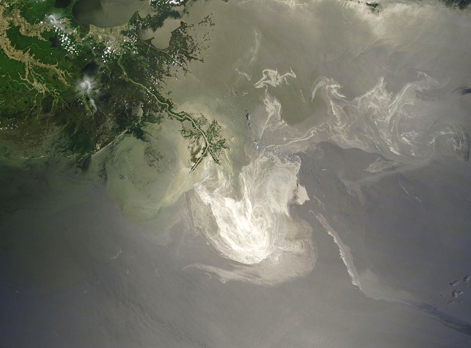
A satellite view of the Deepwater Horizon oil spill

A satellite view of the Deepwater Horizon oil spill

Known as ECOGIG-2 or “Ecosystem Impacts of Oil and Gas Inputs to the Gulf,” the project is a collaborative, multi-institutional effort involving biological, chemical, geological and chemical oceanographers led by the University of Georgia’s Samantha Joye. The research team has worked in the Gulf since the weeks following the 2010 Macondo well blowout.

The three-year, $18.8 million ECOGIG-2 program was funded by the Gulf of Mexico Research Initiative, or GoMRI.

“Our goal is to better understand the processes that have affected the oil spill since 2010,” Edwards said. “How the droplets were dispersed? Where the oil went? How it was taken up by small microbes and also the effects on animals further up the food chain?”

Edwards’ role in the project is to use autonomous underwater vehicles, also called “gliders,” to collect data on conditions around the spill site. Equipped with sensors to measure characteristics such as depth, water temperature, salinity and density, the gliders can cruise the submarine environment for weeks at a time, collecting data and transmitting it back to a ship or a shore station.

Skidaway Institute scientist Catherine Edwards adjusts a glider’s buoyancy with graduate students Sungjin Cho and Dongsik Chan.

Skidaway Institute scientist Catherine Edwards adjusts a glider’s buoyancy with graduate students Sungjin Cho and Dongsik Chan.

“We want to understand the ocean currents—how they change over time and how they change in depth,” Edwards said. “Surface measurements give us a two-dimensional picture of the ocean. Glider data in the vertical provides more valuable information for more fully understanding ocean currents and how they arise.”

The gliders will operate in conjunction with shipboard instruments and also independently. One advantage of using the gliders is they can operate during storms and rough weather, when it may not be possible to use ships. Edwards said shipboard work doesn’t always give a full picture of ocean dynamics simply by the fact that they can only go out when the weather is reasonably clear.

When working in conjunction with research ships, the gliders can provide additional observations, significantly improving the quality of the data set. The gliders also report dissolved oxygen concentrations and optical measurements of chlorophyll and organic matter, and may also be used as a test vehicle for new instruments in development.

Edwards will use “GENIoS,” a new software package, to help navigate the gliders. GENIoS uses high-resolution forecast models of wind and ocean currents, along with information from the glider itself, to calculate the optimal path for the gliders. This will improve the quality of the scientific data collected.

GENIoS is a collaboration among Edwards, Fumin Zhang from the Georgia Institute of Technology and their two Georgia Tech Ph.D. students, Dongsik Chang and Sungjin Cho. GENIos has been tested for more than 210 glider-days on the continental shelf off Georgia and South Carolina. This experiment will be its first test in the Gulf of Mexico.

Edwards also hopes to use this project to test the gliders as platforms for new, experimental sensors developed by other members of the ECOGIG-2 team.

Others involved in ECOGIG-2 include UGA marine sciences faculty Christof Meile, Renato Castelao and Catherine Edwards as well as Annalisa Bracco and Joe Montoya of Georgia Tech.

For additional information, contact Catherine Edwards at (912) 598-2471 or catherine.edwards@skio.uga.edu.

Shrimpers, others join UGA Skidaway Institute Black Gill research cruise

UGA Skidaway Institute of Oceanography scientists are studying a condition in shrimp found along the Southeast Coast known as Black Gill. As part of this effort, a group that included UGA Skidaway Institute scientists and representatives from Georgia Sea Grant, UGA Marine Extension, Georgia DNR, the shrimping industry and researchers from North and South Carolina joined a one-day research cruise on board the R/V Savannah on October 9. The focus of the cruise was to collect shrimp for the Black Gill research project, and also to give the various groups the opportunity to exchange ideas. This account of the project comes from UGA Skidaway Institute scientist and cruise-organizer Marc Frischer.

We had 20 people on board (not including the ship’s crew), representing three states (Ga. S.C. and N.C.) and interests from the industry, management, research, and education/outreach communities. Although sometimes the conversations were outside of my comfort zone, I found the discussions and interactions that I had interesting, significant and useful. I found particularly interesting the perspectives from some of the professional shrimpers who were onboard made it clear to me that a research priority should be investigating the relationship between shrimp mortality in the field and the incidence of Black Gill. Discussions with the management community also provided me new insights into the difficulties we are facing with management and regulation. Conversations with those charged with communicating with the broader public remind me to choose words carefully to avoid misunderstanding.

A shrimp with the Black Gill condition clearly evident.

A shrimp with the Black Gill condition clearly evident.

In terms of the science, the day was largely successful despite the very low shrimp catches. Our priority was to collect enough live shrimp to conduct experiments to investigate black gill transmission and to explore the effect of ciliate infection on molting frequency. Although there were not many shrimp caught, we caught enough to conduct our planned experiments, and we were able to bring live shrimp into our facilities with almost no mortality. Utilizing the relatively large R/V Savannah and being able to dock within feet of our labs made this possible.

Skidaway Institute professor Marc Frischer examining a shrimp.

Skidaway Institute professor Marc Frischer examining a shrimp.

Thanks goes to the director of the Skidaway Institute of Oceanography (Jim Sanders) for making the vessel available to us. Cost for the ship is not covered by funding provided by Georgia Sea Grant and was provided as matching funds by the Institute.

Experiments got underway immediately upon our return and will continue for the next several weeks. If anyone is interested and wants to visit the lab for an update you are welcome to do so.

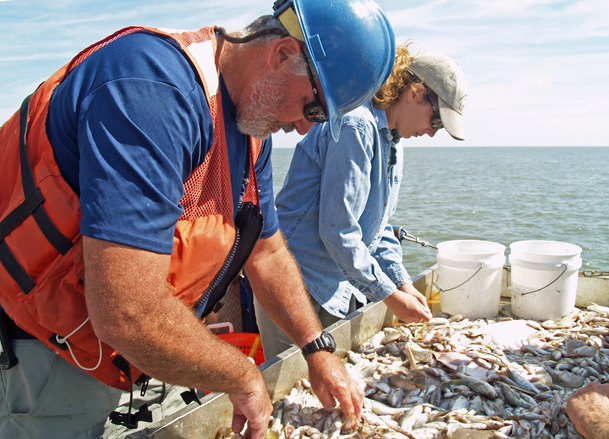
DNR's Pat Geer and Sea Grant's Jill Gambill sort through the marine life caught in a trawl.

DNR’s Pat Geer and Sea Grant’s Jill Gambill sort through the marine life caught in a trawl.

In addition to collecting live specimens, we were able to collect and preserve samples for a large variety of other analyses that will contribute to our identification of the Black Gill agent and to understanding its impact on shrimp. Several of the samples we collected are now on their way to various labs around the world where researchers with expertise beyond ours will study them.

Also, for the first time, we, collected water and sediments to be examined using our novel molecular-based diagnostic tools that are just now coming online. These studies will form the basis of a student project and thus generate both new information and new talent.

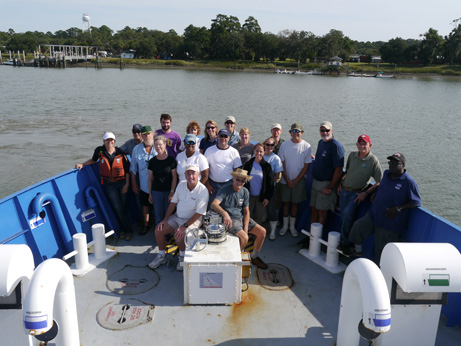
The team from the October Black Gill cruise.

The team from the October Black Gill cruise.

Unfortunately, because we were not able to catch more shrimp, we were not able to quantify the prevalence of Black Gill along the transect we sampled (offshore Wassaw Island, Wassaw Sound, and the Wilmington and Skidaway Rivers). However, this is a task valiantly undertaken by the GA DNR who had just visited the area in September and will be at it again. However, in addition to observing that catches were low everywhere, we were able to estimate a prevalence in the neighborhood of 50 percent. Except for offshore where we only caught one shrimp and it had black gill (so 100 percent). Two insights from this experience — first, our observations agree very well with DNR’s estimates and it is clear that we are probably not sampling sufficiently. Second — engaging the fishing community in this effort, if we can do so in a scientifically sound manner, will be truly helpful.

UGA Skidaway Institute scientists conduct winter 26-hour sampling program

On the weekend of January 24th, a team lead by UGA Skidaway Institute scientist Aron Stubbins conducted the latest “26 Hours on the Marsh” sampling program on the bluff at Groves Creek on the Skidaway Institute campus. The project was designed to investigate how salt marshes function and interact with their surrounding environment—specifically how bacteria consume and process carbon in the marsh. The team collected water samples throughout two complete tidal cycles, during both the day and night.

The outdoor laboratory on the bluff at Groves Creek.

The outdoor laboratory on the bluff at Groves Creek.

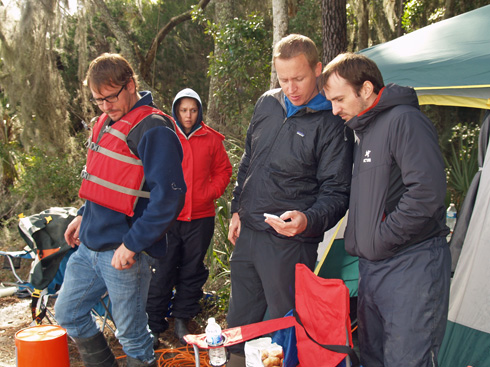
Skidaway Institute's Zac Tait, Thais Bittar, Rob Spencer (FSU) and Aron Stubbins prepare for a sample collection.

Skidaway Institute’s Zac Tait, Thais Bittar, Rob Spencer (FSU) and Aron Stubbins prepare for a sample collection.

Zac Tait collects a water sample from a skiff tied to the bank.

Zac Tait collects a water sample from a skiff tied to the bank.

Thais Bittar and Zac Tait begin to process the water sample.

Thais Bittar and Zac Tait begin to process the water sample.

About a dozen scientists and students were involved in the project. “26 Hours on the Marsh” is supported by two grants from the National Science Foundation. The grants total $1.7 million that represent larger, three-year, multi-institutional and multi-disciplinary research projects into salt marsh activity. These projects bring together faculty, students and staff from UGA’s Skidaway Institute, the University of Tennessee, Florida State University and Woods Hole Research Center. UGA Skidaway Institute scientists include principal investigator Jay Brandes; chemical oceanographers Aron Stubbins and Bill Savidge; physical oceanographers Dana Savidge, Catherine Edwards and Jack Blanton; and geologist Clark Alexander.

UGA study finds high marine debris, need for standardized reporting along Georgia coast

By Molly Kate Berg

University of Georgia researchers are hoping to find a consistent way to record the marine debris—particularly pieces of plastic—crowding Georgia’s beaches as part of an effort to find a solution for the growing problem.

Marine debris has been washing up on Georgia beaches and uninhabited islands for years. Combating the issue starts with figuring out how big it is, and a new two-part study from the UGA Skidaway Institute of Oceanography and Marine Extension published online in the Marine Pollution Bulletin finds that marine debris reporting can improve if it becomes standardized.

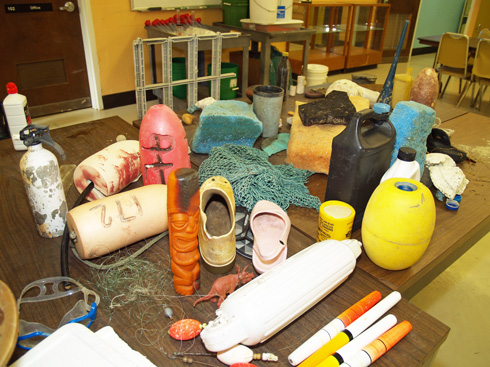
A sample of marine debris collected along the Georgia coast sits on a table at the UGA Marine Education Center and Aquarium.

A sample of marine debris collected along the Georgia coast sits on a table at the
UGA Marine Education Center and Aquarium.

The problem right now is this: A volunteer group goes out and records the weight or volume of the marine debris collected. However, volunteers don’t often record the specific square feet measured or the contents of the debris. Due to a lack of report standardization, researchers often can’t compare the marine debris, especially plastic fragments, reported by different groups.

“We’ve seen plastic usage go up dramatically,” said study co-author Dodie Sanders, a marine educator and outreach coordinator for UGA Marine Extension, a unit of the Office of Public Service and Outreach. “It’s an important 21st century global issue. We need to learn more to better understand the issues of marine debris.”

The study’s lead author Richard F. Lee, professor emeritus with the UGA Skidaway Institute of Oceanography, agrees.

“Plastic debris is created on land and then it goes into rivers, flows into the ocean and washes up on land,” he said. “We’ve found that plastic debris ends up not only on populated beaches, but on inaccessible islands as well. We’ve found plastic everywhere on the coast.”

The first part of the study gathered debris from 20 sites along Georgia’s coast, including Tybee, Cumberland and Ossabaw islands. The debris was reported from volunteer organizations like Clean Coast, which hold monthly beach and marsh cleanups in Georgia.

“The volunteer groups reported the weight of the debris, though we didn’t know the exact amount of plastic,” Lee said. “Based off the volunteer information we received, we did a follow-up study to more precisely measure the marine debris in a fixed location and period of time.”

The total collected debris ranged from 180 to 1,000 kilograms. The levels of plastic debris differed at each site over the course of the study, though plastic was consistently among the mix. Found plastic included bottles, wrappers, food utensils and fragments of fishing gear.

Sanders spearheaded the second part of the study, where she and students collected plastic debris from Skidaway and Wassaw islands over a period of two years.

“While Dr. Lee did data analysis, I did some of the field work,” Sanders said. “We picked the two islands in the second part of the study because they were accessible sites where Marine Extension often takes students for marine education.”

For the fieldwork, Sanders and students visited the islands each month. They took inventory of what kinds of plastics were on specific areas of the coast.

“On about a monthly basis, I would take students to learn about debris and tally all the items on the islands,” Sanders said. “We took areas of 200 meters by 40 meters and recorded the items found. We also used GPS units to mark what areas we had done.”

The students, many of them in middle and high school, came from all over Georgia to assist. As part of Marine Extension, Sanders regularly teaches visiting students about marine life. When students volunteered to clean up, she tried to emphasize the issues surrounding debris.

“The bulk of the plastic comes from land,” Sanders said. “When people think of marine debris, they think of the ocean. I try to emphasize watershed concepts—what happens upstream ultimately gets downstream.”

“It can take years for plastic to degrade,” Lee said, adding, “80 percent of the plastic found at Wassaw turned out to be fragments. The fragments then spread and can have a number of environmental effects.”

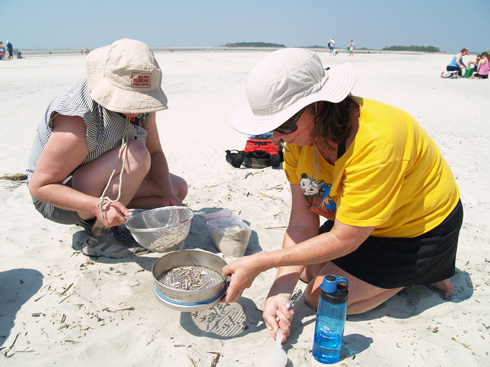
Participants in a July 2014 teacher’s workshop focusing on marine debris sift through the sands of Tybee Island in search of microplastic particles.

Participants in a July 2014 teacher’s workshop focusing on marine debris sift
through the sands of Tybee Island in search of microplastic particles.

Sanders says that since plastic debris is everywhere on the coast, it has to be addressed and reported efficiently to reduce its effects.

“There are proactive and reactive approaches to the issues of marine debris, and both are important,” she said. “We’ve been reactive so far by picking up debris. The proactive approach is our role in educating the public and researching the negative impacts of marine debris.”

The study was supported by the Georgia Department of Natural Resources Coastal Incentive Grant, NOAA Southeast Atlantic Marine Debris Initiative and the NOAA Marine Debris Program.

The full article on “The amount and accumulation rate of plastic debris on marshes and beaches on the Georgia coast” is available at www.sciencedirect.com/science/article/pii/S0025326X14008200#.