Category Archives: skidaway campus notes

Skidaway Island Marathon organizers support UGA Skidaway Institute

The organizers of the 2017 Skidaway Island Marathon recently presented a donation of $600 to the Associates of Skidaway Institute. Endurance Race Services organized the March 25 race, which had both its start and finish lines on the UGA Skidaway Marine Science Campus. The marathon organizers support a number of area nonprofits with the race proceeds. This was the third year the Skidaway Island Marathon was based out of the Skidaway campus.

Dan Pavlin (l) from Endurance Race Services presents a check to Skidaway Institute interim executive director Clark Alexander.

Jay Brandes collaborator on research paper

UGA Skidaway Institute professor Jay Brandes is a collaborator on a recent publication focusing on the roles of methane, iron and microbes in regulating the temperature of the primordial ocean. The research team was led by Georgia Tech Ph.D. student Marcus Bray. An article describing the project, can be found here.


Gray’s Reef hosts MATE ROV competition

By Michelle Riley
Gray’s Reef National Marine Sanctuary

Gray’s Reef National Marine Sanctuary hosted its annual Southeast Regional Marine Advanced Technology Education (MATE) Remotely Operated Vehicle (ROV) competition on April 22 at the Chatham County Aquatics Center.

Spearheaded by Gray’s Reef’s events and volunteer coordinator Jody Patterson, staff and volunteers from the sanctuary as well as Gray’s Reef National Marine Sanctuary Foundation welcomed 16 teams of students who came to compete for first place and a shot to compete in the national MATE competition. The competition is open to young scientists from kindergarten to college, and it challenges them to create innovative solutions to real-world problems faced by the National Oceanic and Atmospheric Administration and other marine industries.

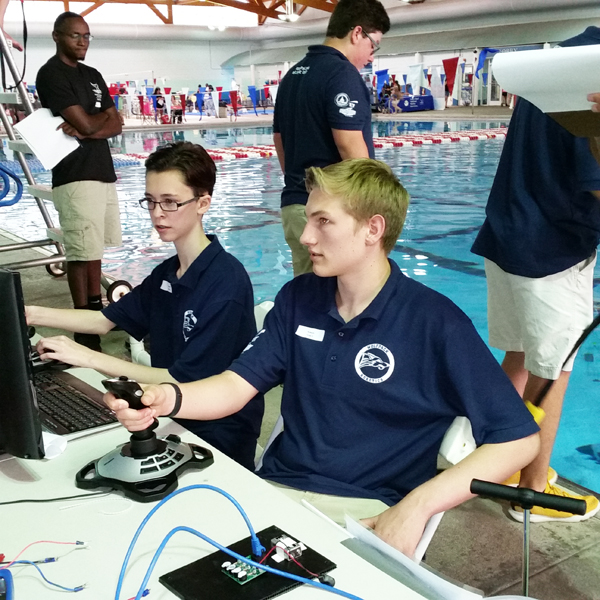
The Wolfpack Robotics Team from North Paulding High School competing, first place winners. Photo Credit: Michelle Riley

This year’s theme was “Port Cities of the Future,” which prompted students to use their underwater robots to perform tasks that could be utilized to clean and maintain the waters of port cities. MATE encourages students to develop their entrepreneurial skills by creating a business plan that supports their innovative marine technology as well as marketing materials that showcase their work. Students choose from four classes of competition in which they can present their marketing materials and demonstrate their robots.

Vying for a spot at the international competition was the eight-time champion team named InnovOcean from Carrollton High School as well as five other teams in the ranger class. Although the competition was fierce all day, in the end, first place fell to the Wolfpack Robotic Team from North Paulding High School in Dallas, Georgia. Gray’s Reef congratulates all the teams that competed in the Southeast regional competition and will be cheering on the Wolfpack Robotic Team in June as they compete in the international competition in Long Beach, California.

UGA Skidaway Institute launches new website

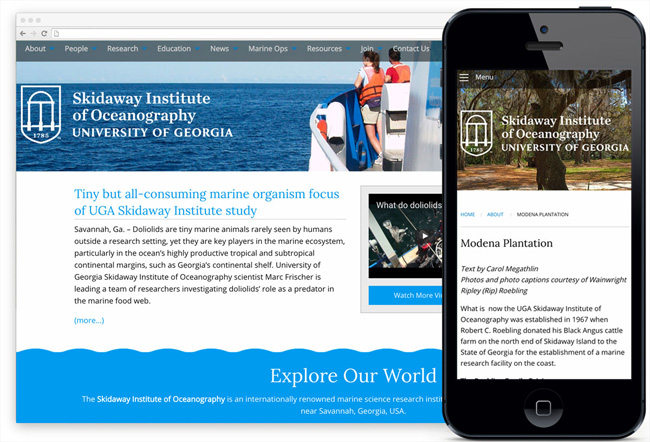
UGA’s Skidaway Institute of Oceanography launched its new website in April. Keeping the old URL, www.skio.uga.edu, the new site is more functional and visually appealing. The site was designed by Heideldesign, a Savannah-based firm, and the content was created by the Skidaway Institute’s staff.The new site is easily navigable and uses photography from the Skidaway Institute campus. It utilizes a blue color pallette and wave graphics to reflect the institute’s focus on the ocean world.

The main site content is divided into the research center’s four disciplinary areas, allowing visitors and prospective and current students to dig in deeper to the study area of their choice. Faculty members have their own profile pages as well as lab pages, and each faculty member can log on to the site and add information, files, videos and photos. In addition, the site provides a wealth of content, including images and videos, on Skidaway Institute research, operations, outreach and resources.

The new site is powered by the content management system WordPress, which means administrators can also easily add news releases, publications and other information, keeping site content fresh and up to date.

Rider helped educate UGA Aquarium visitors, now back in his natural habitat

by Emily Woodward

Rider, a loggerhead sea turtle which spent the last three years at the UGA Marine Education Center and Aquarium, was returned to his natural home in the ocean.

Lisa Olenderski gives Rider a little encouragement to walk to the ocean.

“It went well,” said Devin Dumont, head curator at the aquarium. “Rider seemed a little unsure at first, but after we placed him in the water, his instincts kicked in and he went on his way.”

Prior to the release, Rider was tagged by Joe Pfaller, research director of the Caretta Research Project, so that he can be identified if encountered again. After receiving the tags, the 50-pound sea turtle was loaded onto a skiff and transported to Wassaw Island National Wildlife Refuge.

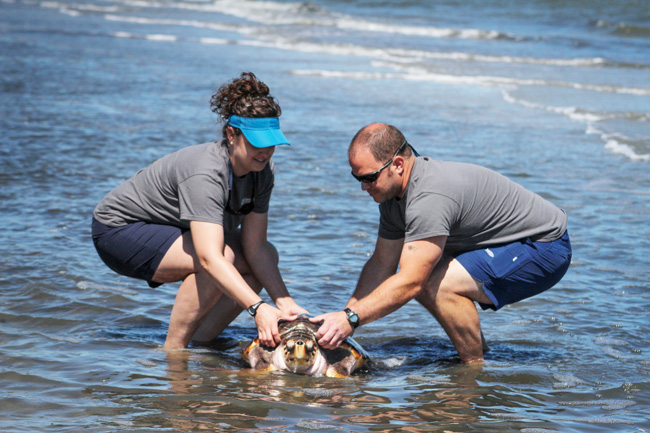
Once at the beach, Dumont and Lisa Olenderski, assistant curator at the aquarium, lifted him from his tub and placed him on the sand. Rider crawled forward a few inches before stopping, as if not quite sure what to do next. With a little help from Dumont and Olenderksi, Rider eventually made it to the surf where he swam in circles a few times, orienting himself to his new surroundings, before disappearing into the waves.

Lisa Olenderski and Devin Dumont help Rider into the surf.

Rider arrived at the UGA Marine Education Center and Aquarium as a straggler discovered during a nest excavation by members of Caretta Research Project who monitor the sea turtle nests on Wassaw Island. Stragglers that don’t make it out of the nest with the rest of the hatchlings typically have a much lower chance of survival. By giving them a temporary home at the aquarium, it increases the likelihood that they’ll make it in the wild.

Rider played an important role educating visitors to the UGA Aquarium. As an ambassador sea turtle, he was featured in multiple marine education classes and outreach programs for all age groups, from pre-K to adult.

“We estimate that Rider saw about 70,000 visitors,” said Olenderski. “If each of those people left knowing just one new fact about sea turtles or gained a new appreciation for them, it’s all worth it.”

In preparation for the release, Rider was fed live food, such as blue crabs and mussels, to practice active foraging and hunting skills. Prior to the release, the aquarium staff also received approval from the Georgia Department of Natural Resources and Terry Norton, a veterinarian, and director and founder of the Georgia Sea Turtle Center on Jekyll Island.

“We’re always appreciative of the opportunity to work with multiple partners on the coast through our ambassador sea turtle program,” said Dumont. “Because of this collaborative effort, Rider has a much stronger chance of making it to adulthood.”

Symposium highlights UGA Marine Extension and Georgia Sea Grant impacts

When Hurricane Matthew hit the Georgia coast last October washing away some of its sandy shoreline, UGA was ready.

With funding from Georgia Sea Grant, the UGA Skidaway Institute of Oceanography already was studying sand resources and creating an inventory of sand deposits along the coast. Researchers are using that inventory to identify areas where sand was available to replenish the coastline that was lost during the storm. Replacing the lost sand is important to protect lives and property, as well as critical habitats, from coastal hazards.

“The sand resources in our state waters are the most poorly known of all the states along the east coast,” said Clark Alexander, interim director of Skidaway Institute. “This research enables us to create maps identifying offshore areas that are suitable for beach nourishment and habitat restoration projects. With these data, we can know where suitable sand exists if we need it in the future after major storms.”

Clark Alexander

Alexander was one of many researchers across Georgia who presented a project during the Marine Extension and Georgia Sea Grant Research Symposium in Athens on June 1. The annual symposium provides an opportunity for researchers to share their Sea Grant-funded work, network with others in the scientific community and look for collaborative ways to tackle the latest issues impacting the coast.

“Case studies presented during the symposium aptly illustrated Georgia Sea Grant’s success in elevating awareness of coastal issues, increasing local communities’ resilience to the effects of a changing climate and developing models that can be replicated to improve conditions on a global scale,” said Paul Wolff, chair of the Marine Extension and Georgia Sea Grant Advisory Board.

Marc Frischer describes research into black gill in shrimp.

From projects that look at how to get local seafood into inland markets to those that measure the productivity of Georgia’s expansive salt marshes, Sea Grant-funded research spans a variety of topics and emphasizes the importance of multidisciplinary, collaborative research and outreach to effectively enhance coastal communities and ecosystems.

Research proposals submitted to Georgia Sea Grant are expected to include an education and outreach component to ensure that results reach beyond the research community and are delivered to a diverse audience.

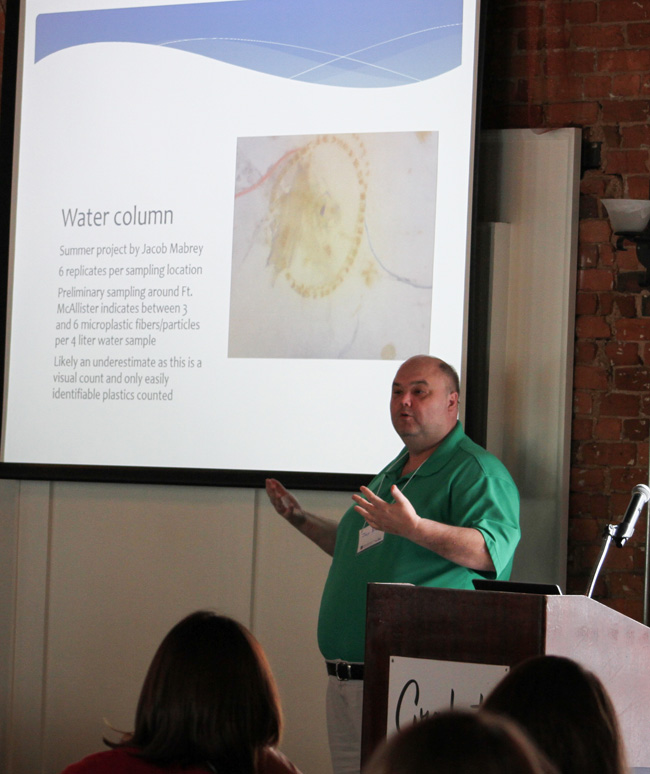
Jay Brandes presents his research into microplastics on the Georgia coast.

Education and extension faculty and staff at Marine Extension and Georgia Sea Grant work to incorporate Sea Grant-funded research into public programs, workshops and curricula targeted to pre-k through college age students, resource managers, decision makers, the seafood industry and beyond.

“We received a record number of research funding preproposals this year and many of those submitting full proposals attended the research symposium,” said Mark Risse, director of Marine Extension and Georgia Sea Grant. “Being able to learn from projects that have proved successful should strengthen research efforts and allow us to support projects that move rapidly to application and impact.”

Kayla Clark describes the Sea Grant intern program.

Other presenters from the Skidaway Marine Science Campus included UGA Skidaway Institute professors Jay Brandes and Marc Frischer, and from Marine Extension, associate director for marine education Anne Lindsay and public programs coordinator Kayla Clark.

UGA Skidaway Institute researchers probe complex Atlantic Ocean currents

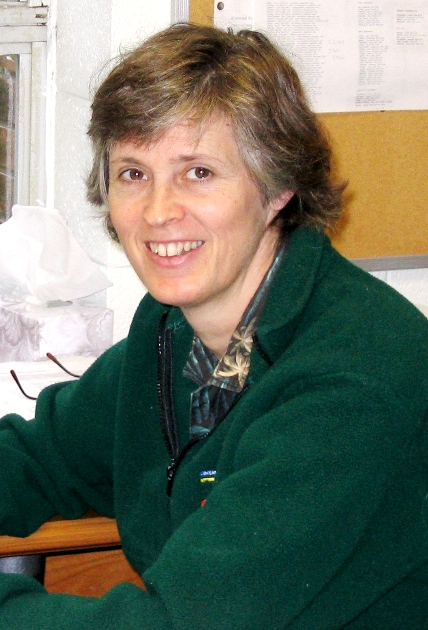
Dana Savidge

The ocean off the coast of North Carolina has a complex system of ocean currents that make it one of the least understood areas on the U.S. Eastern Seaboard. University of Georgia Skidaway Institute of Oceanography professor Dana Savidge is leading a team of scientists, including UGA Skidaway Institute scientist Catherine Edwards, working to unravel the mysteries of the complex ocean currents near Cape Hatteras.

The four-year project, informally called PEACH: Processes driving Exchange At Cape Hatteras, was launched in early 2016 and is funded by a $5 million grant from the National Science Foundation to better understand the relationship between the waters of the continental shelf and the deep ocean.

“The U.S. continent, like others, has a shallow ocean immediately around it, called the continental shelf. It’s like an apron that extends out from the shoreline and it is fairly shallow, only about 60 meters deep,” Savidge said. “At its outer edge, the bottom drops sharply into the deep ocean, which can be miles deep.”

Exchange at the shelf edge can push cold, nutrient-rich water from the deep ocean onto the shelf, which drives productivity of marine algae and the food web that it supports.

“There’s a reason people love offshore fishing at the edge of the Gulf Stream,” said Edwards. “Areas with regular exchange of shelf and deep waters are often known hot spots for commercial and recreational fishing.”
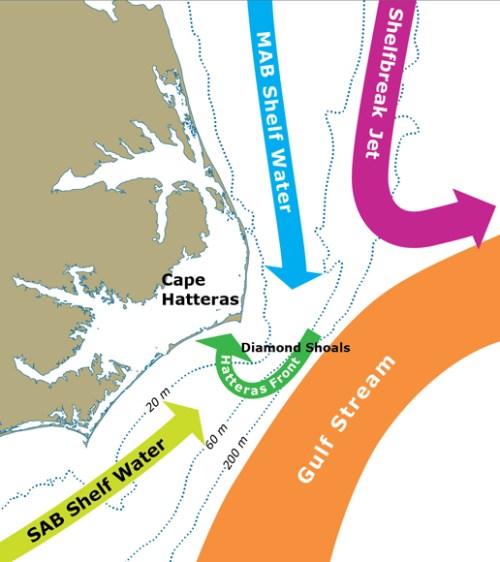
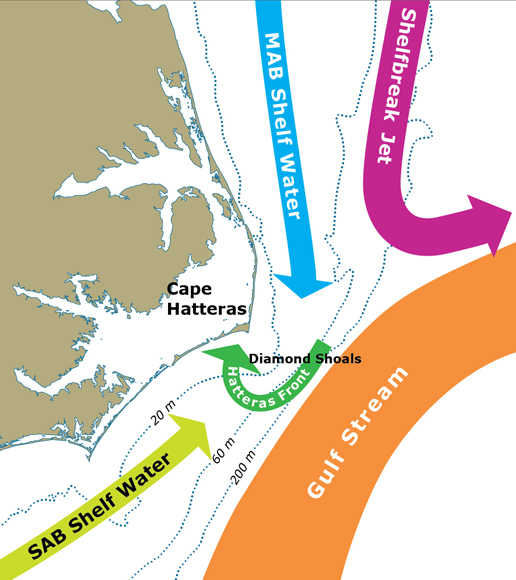
One reason Cape Hatteras attracted the researchers’ attention is that two opposing deep ocean currents collide there, making the ocean there highly dynamic. The warm Gulf Stream hugs the edge of the continental shelf as it flows north from the tip of Florida. At Cape Hatteras, the Gulf Stream opposes a colder current, the Slope Sea Gyre current, that moves southward along the mid-Atlantic coast. There, the Gulfstream breaks away from the coast toward northern Europe.

There is a convergence of shelf currents at Cape Hatteras as well, as cool shelf waters of the mid-Atlantic continental shelf meet the warm salty shelf waters from the south. Each of these currents, on the shelf and at the shelf edge, has a distinct temperature, salinity, and often a biological signal that reflects the origin of the water it carries. The team will measure these properties and ocean currents to better understand the exchange processes.

During the first year of the study, the researchers prepared and installed a network of sophisticated, high-tech instruments on the shore and in the ocean to monitor and capture the movement of water and changing properties like temperature and salinity. Together with scientists from the University of North Carolina and North Carolina State University, the team has worked with ocean models to better understand the interaction between shelf currents and the deeper currents of the Gulf Stream and the Slope Sea Gyre.

“Circulation on the continental shelf and the deep ocean can be quite separate things, but their effects on one another can be quite complicated,” Savidge said.
In addition to subsurface packages moored on the sea floor, the PEACH team is taking advantage of modern sampling techniques with shore-based radar systems and autonomous underwater vehicles called gliders to collect data remotely.
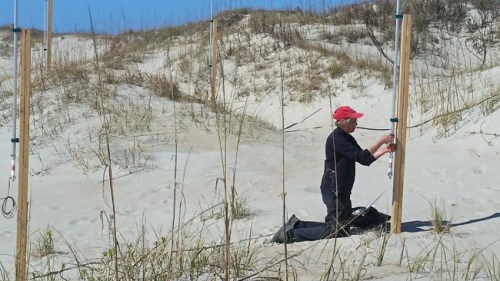
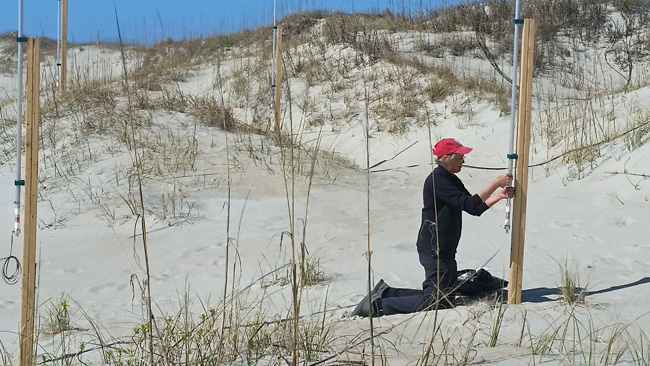
Savidge working on a radar antenna on the Outer banks.

Savidge’s hardware contribution to the project is a series of low-power, high-frequency radar stations that scan the waters of the continental shelf and measure the speed and direction of surface currents.

“Measuring surface currents remotely with the radars is a real advantage here,” Savidge said. “They cover regions that are too shallow for mobile vehicles like ships to operate, while providing detailed information over areas where circulation can change quite dramatically over short times and distances.”
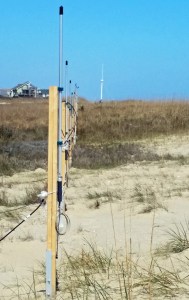
An array of radar antennae on an Outer Banks beach.

Savidge’s research technician, Gabe Matthias, installed the radar systems on the beach at Salvo and Buxton, and at the airports at Frisco and Ocracoke, North Carolina. Currently, the researchers are working out the bugs in the system and getting the four stations to work together to paint a composite picture of the surface currents. The radars produce a massive amount of data to be processed.

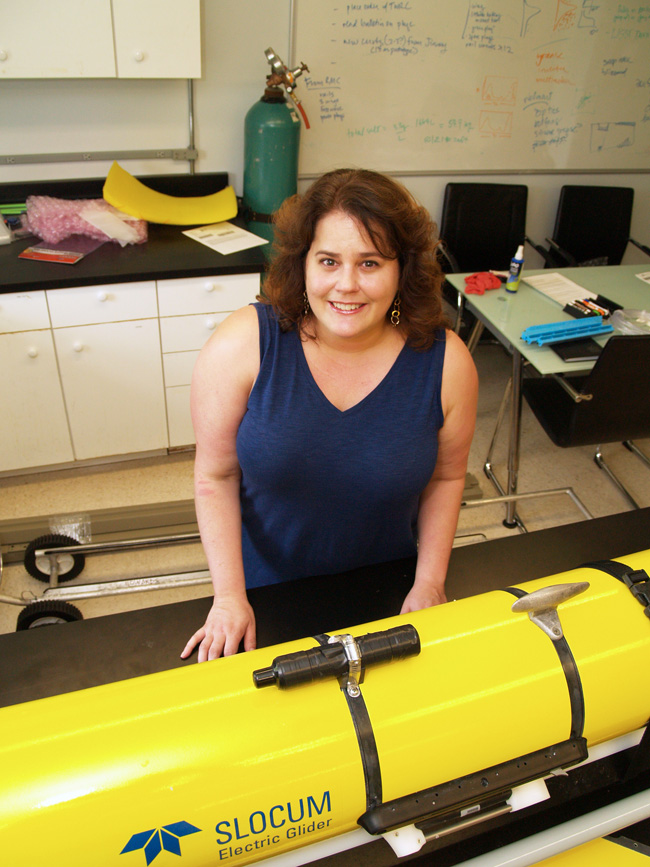
Edwards leads the effort to use gliders that will operate on the shelf for nearly the entire 16-month experiment. Gliders are shaped like torpedoes and equipped with sensors to measure properties like temperature, salinity and dissolved oxygen. They can be programmed to cruise the underwater environment for weeks at a time, surfacing at regular intervals to transmit its collected data via a satellite phone.
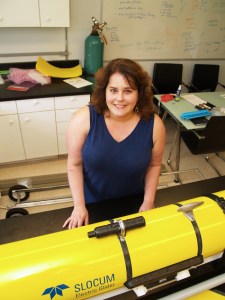
Edwards in her lab with a glider.

Edwards’s specialty is improving the way these gliders sample the coastal waters using information from models and real-time data streams, including surface currents from Savidge’s HF radar. Edwards and doctoral students Qiuyang Tao and Mengxue Hou, co-advised by Edwards and Fumin Zhang of Georgia Tech, have developed new systems that optimize the path of the gliders based on near real-time information about current patterns and how they are expected to change, making operations more efficient and allowing better data collection.

“The glider provides data that help explain how temperature, salinity, and density change in space and time underwater, and the HF radar provides high resolution maps of surface currents every 20 minutes,” said Edwards. “The two systems are highly complementary, and their combination provides an unprecedented view of when, where, and why there is exchange between the shelf and deep ocean.”

According to Savidge, the study should produce a greater understanding of the forces at work at Cape Hatteras with implications across a wide range of interests from fisheries management to pollution control. Microscopic marine plants, known as phytoplankton, are a vital part of the marine ecosystem. Phytoplankton are the very base of the marine food web and they produce approximately half the oxygen in the atmosphere. In addition to tracking deep water inputs that support productivity on the shelf, Savidge said, it would is also be important to understand any processes that transport carbon-rich shelf water back to the deep ocean. When phytoplankton and the rest of the food web convert nutrients into their own biomass, water returned to the deep ocean can carry large quantities of organic carbon with it.

The knowledge gathered at Cape Hatteras will be applicable to other oceans around the world.

“Cape Hatteras is the ideal place to look at these processes that you are going to find elsewhere,” Savidge said. “You have a lot of energetic forcing and everything is concentrated in a very small space, with large variations over short distances. The idea is to understand the processes so you can model them effectively. If you can do that, you can anticipate how circulation on the shelf and exchanges with the deep ocean will respond to changes in the Gulf Stream or the wind over time.”

The project will run through March 2020. The other members of the research team are Harvey Seim and John Bane of the University of North Carolina; Ruoying He of North Carolina State University; and Robert Todd, Magdalena Andres and Glen Gawarkiewicz from Woods Hole Oceanographic Institute.

Savidge expressed special appreciation to the National Park Service and the North Carolina Department of Transportation for providing sites for the radar installations, and the University of North Carolina’s Coastal Studies Institute for help in installing them.

UGA Skidaway Institute scientists study microbial chemical warfare

In the battlefield of the microbial ocean, scientists have known for some time that certain bacteria can exude chemicals that kill single-cell marine plants, known as phytoplankton. However, the identification of these chemical compounds and the reason why bacteria are producing these lethal compounds has been challenging.

Now, University of Georgia Skidaway Institute of Oceanography scientist Elizabeth Harvey is leading a team of researchers that has received a $904,200 grant from the National Science Foundation to fund a three-year study into the mechanisms that drive bacteria-phytoplankton dynamics.

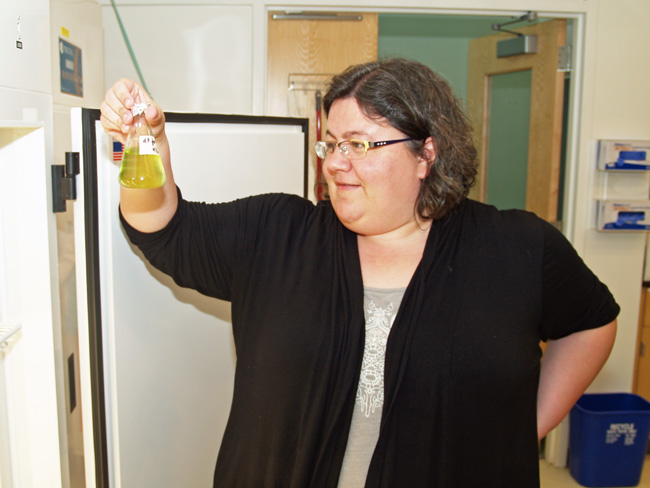
Researcher Elizabeth Harvey examines a part of her phytoplankton collection.

Understanding these dynamics is important, as phytoplankton are essential contributors to all marine life. Phytoplankton form the base of the marine food chain, and, as plants, produce approximately half of the world’s oxygen.

“Bacteria that interact with phytoplankton and cause their mortality could potentially play a large role in influencing the abundance and distribution of phytoplankton in the world ocean,” Harvey said. “We are interested in understanding this process so we can better predict fisheries health and the general health of the ocean.”

A microscopic view of a population of phytoplankton.

This project is a continuation of research conducted by Harvey and co-team leader Kristen Whalen of Haverford College when they were post-doctoral fellows at Woods Hole Oceanographic Institution. They wanted to understand how one particular bacteria species impacted phytoplankton.

“We added the bacteria to the phytoplankton and the phytoplankton died,” Harvey said. “So we became very interested in finding the mechanism that caused that mortality.”

They identified a particular compound, 2-heptyl-4-quinlone or HHQ, that was killing the phytoplankton. HHQ is well known in the medical field where it is associated with a bacterium that can cause lung infections, but it had not been seen before in the ocean. The team will conduct laboratory experiments to determine the environmental factors driving HHQ production in marine bacteria; establish a mechanism of how the chemical kills phytoplankton; and use field-based experiments to understand how HHQ influences the population dynamics of bacteria and phytoplankton.

“This project has the potential to significantly change our understanding of how bacteria and phytoplankton chemically communicate in the ocean.” Harvey said.

The project will also include a strong education component. The researchers will recruit undergraduate students, with an effort to target recruitment of traditionally under-represented groups, to participate in an intense summer learning experience with research, field-based exercises and some classroom work.

“The idea is for the students to return to their home institutions at the end of the summer, but to continue to work with us on this project,” Harvey said. “This will be a unique opportunity to offer students cross disciplinary training in ecology, chemistry, microbiology, physiology and oceanography.”

In addition to Harvey and Whalen, the research team includes David Rowley of the University of Rhode Island.

UGA Skidaway Institute grad student receives master’s degree

Former UGA Skidaway Institute and Savannah State University graduate student Ashleigh Price successfully defended her master’s thesis before her committee and a public audience on November 8.

She officially received her degree on Dec. 10.

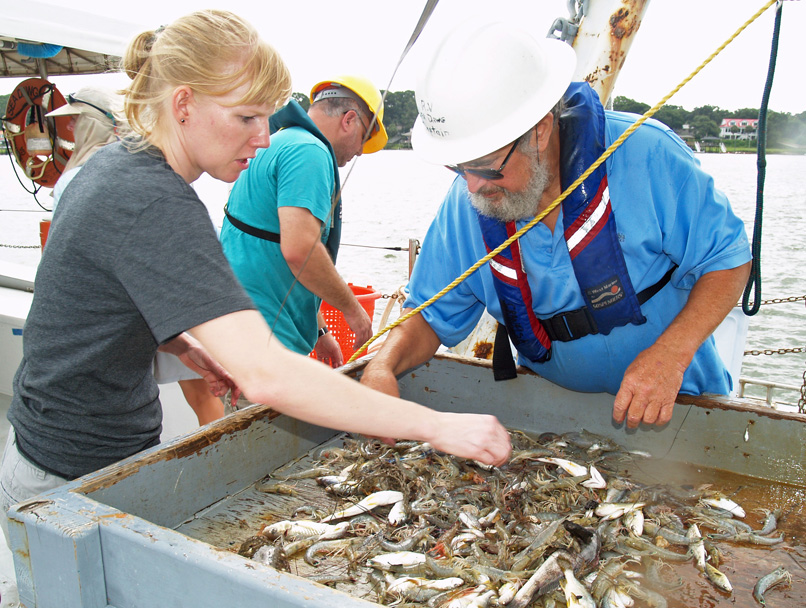
Ashley Price sorts the product of a trawl with John "Crawfish" Crawford on board the UGA Research Vessel Sea Dawg.

Ashley Price sorts the product of a trawl with John “Crawfish” Crawford on board the UGA Research Vessel Sea Dawg.

Ashleigh did most of her research as part of Marc Frischer’s lab at Skidaway Institute. The title of her thesis is “Environmental Reservoirs and Mortality Associated with Shrimp Black Gill.”

The Roebling barn in perspective

by Debbie Jahnke

Editor’s notes: Debbie and Rick Jahnke were longtime members of the Skidaway Institute family. Rick was a faculty scientist and, for several months, interim director of the institute. Debbie was his research coordinator. They both retired in 2008 and moved to Port Townsend, Washington.

 In March of this year, the Georgia General Assembly approved a $3 million bond issue to renovate and repurpose the old Roebling cattle show barn at UGA Skidaway Institute into usable laboratory and meeting space.

In 1986, Rick Jahnke interviewed for a faculty position at Skidaway Institute of Oceanography. At the time, he was a research scientist at Scripps Institution of Oceanography. Rick returned home to San Diego with the impression that he wouldn’t be hired because Stuart Wakeham had also interviewed for the position and would undoubtedly be selected. Instead, Skidaway Institute came up with the funds for two positions and hired both Rick and Stuart.

Rick’s start-up requests to Skidaway Institute were modest: a germanium detector and a desktop computer. He also requested lab and office space in the Roebling building and a staging lab in the barn for maintenance, repair and modification of his various seagoing autonomous vehicles. The barn was nearly perfect for that purpose, with plenty of storage space and a central open area that allowed loading and offloading of equipment with a hand-winched pulley system.OLYMPUS DIGITAL CAMERA

Rick didn’t need any extra space for me and, instead, split his office with a wall so there was a spot just big enough for my desk and a “labradog” named Daisy. I was the analytical tech for his research and he hired an equipment tech for the seagoing operations. The barn lab operations expanded to the second floor of the barn when it became clear that anyone interested in measuring natural levels of C-14 wasn’t going to be able to do it in many existing Skidaway Institute labs. In the free-form early days of productivity measurements, enough C-14 made it into the ambient spaces of many Skidaway Institute labs that C-14 dating indicated that our labs existed about 50,000 years in the future. The levels of so-called contamination were in no way concerning for health or safety, but they made natural abundance measurements impossible without a “clean” space for sample storage. The bright yellow room with the pink and green interior and cold room on the second floor of the barn were the result.

The interior today

The interior today

From those barn labs, autonomous vehicles were staged, packed and deployed for oceanographic research off western Africa, Peru, Panama, New Guinea, deep shelves off Cape Hatteras, California, Oregon and other locations, as well as the Georgia shelf. Samples were returned and stored in the yellow lab upstairs.

The barn provided another opportunity for me when I was drafted in a weak moment to try to improve what was quite dismal visitor housing at Skidaway Institute in the 1980s. The first housing we made habitable was the barn apartment. As we worked through the process of getting three NSF grants for housing, we also were able to set up a small laundry room in the barn so that volunteers could keep clean linens in the housing we did have. The first successful grant built the quadraplex (Menzel, Zeigler, Carpenter and Knight apartments). The second grant rehabilitated the housing that existed since the plantation days (the barn apartment, now renamed Baggett, Rice House, Thomas and Martin apartments). The third grant built the Commons. I spent many hours in that barn laundry room while most of my weekends and holidays were spent cleaning housing units before the institute finally figured out how to pay someone to do that as a real job.

Rick and I retired in 2008 and headed west with our five cats. All I know of the modern Skidaway Institute is what I read on the website and Facebook pages and occasional emails from friends still there. Skidaway was wonderful to us and the barn was a big part of the ease with which our research was facilitated. It was with considerable pleasure that we learned of the grand and useful future being planned for the good old barn.