Tag Archives: skidaway institute

Evening @ Skidaway launches UGA Skidaway Institute’s 50th anniversary celebration

Since 1968, when the Skidaway Institute of Oceanography was founded, the science of oceanography has grown by giant proportions. Now a part of the University of Georgia, Skidaway Institute has been in the middle of that growth, conducting marine research from the coast of Georgia to sites all over the world.

The story of that growth and how UGA Skidaway Institute contributed to it will be the focus of a special Evening @ Skidaway program on Tuesday, Feb. 20, in the McGowan Library on the University of Georgia Skidaway Marine Science Campus. (10 Ocean Science Circle, Savannah, GA 31411) The event will begin with a reception at 6:15 p.m., followed by the program at 7 p.m.
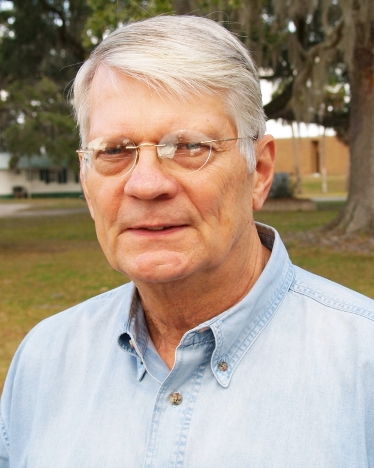
Herb Windom

In a talk titled “50 Years of Science at Skidaway Institute: People, Platforms and Partnerships,” Skidaway Institute scientist Herb Windom will look back at the amazing progress of marine research and the way it has opened mankind’s eyes to the wonders and mysteries of the ocean.

In 1968, Windom was the first faculty scientist hired at Skidaway Institute of Oceanography. As he conducted his own research, he also watched the science grow as new researchers and technology allowed scientists to answer questions they hadn’t known to ask years earlier. Windom also served as director of the Institute for several years in the 1990s. He retired in 2001, but remains active as an emeritus professor, conducting research and advising other scientists.

The program is open to the public, and admission is free. Space is limited. To reserve a seat, please call (912) 598-2325 or email mike.sullivan@skio.uga.edu.

The Evening @ Skidaway program will kick off a year-long series of special events to celebrate the Institute’s 50th anniversary.

March 13 — Dr. Bill Savidge / So how much is a salt marsh really worth?
April 10 – Dr. Dana Savidge / Ocean Forces in the Graveyard of the Atlantic
May 15 — Open Lab Night / Visit informally with researchers in their labs.
June 12 –Dr. Catherine Edwards/ Exploring the Ocean with Underwater Robots
July 10 — Open Lab Night
August 14 — Dr. Cliff Buck / Ocean Acidification: The Other Carbon Problem
September 11 — Dr. Clark Alexander / Sea Level Rise and What It Means to Coastal Georgia
October 9 —  Dr. Jay Brandes / Microplastics: The New Pollution
November 13 — Dr. Elizabeth Harvey / The Magnificent World of Plankton
Glider partners come to the rescue during Hurricane Irma

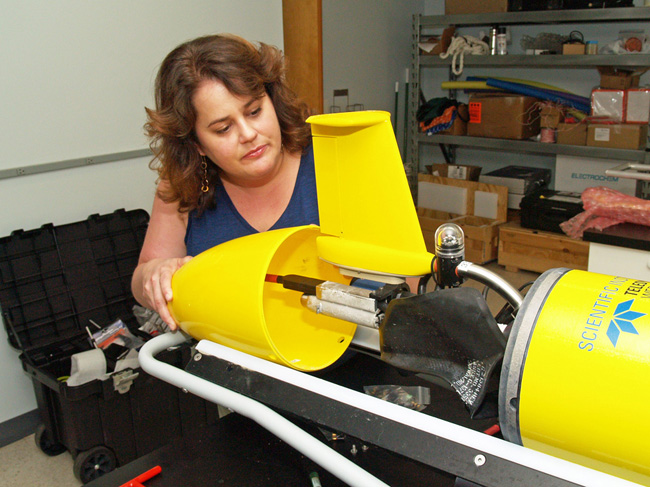
Hurricane Irma presented an interesting problem to UGA Skidaway Institute scientist Catherine Edwards and other glider operators in the Southeast. They had several autonomous underwater vehicles or “gliders” deployed off the east coast as the hurricane approached, including Skidaway Institute’s glider, “Modena.” Edwards and the others were confident the gliders themselves would be safe in the water, but the computer servers that control them would not.

Catherine Edwards works on “Modena.”

The gliders are equipped with satellite phones. Periodically, they call their home server, download data and receive instructions for their next operation. It was expected that Skidaway Institute would lose power for at least several days (as did happen). However, Skidaway’s backup server partner at the University of South Florida’s marine science facility in St. Petersburg, Fla. was also directly in the storm’s projected path.

“In the week before she hit, Irma sort of blew up our hurricane emergency plans,” Edwards said.

Several other options, including Teledyne Webb’s back-up servers and Rutgers University were not feasible for technical reasons. Glider operators at Texas A&M University came to the rescue. Catherine was able to instruct “Modena” to switch its calls over the Texas A&M server. No data was lost and “Modena” continued its mission.

According to Edwards, two big lessons emerged from the experience.

“First, most of us rely on nearby or regional partners for emergency and backup support, but disasters are regional by nature, and the same Nor’easter or hurricane can take you down along with your backup,” she said. “Second, there aren’t a lot of glider centers that can absorb several gliders on a day’s notice, and there are some compatibility and operations issues involved, so it is best to identify our potential partners and build out these steps into our emergency plans well in advance.”

UGA Skidaway Institute scientist to spend winter 2020 locked in Arctic ice

Cliff Buck

Spending the Christmas holidays and the better part of January and February on a ship frozen solid in the Arctic ice cap isn’t most people’s idea of a great way to spend the winter. However, University of Georgia Skidaway Institute of Oceanography scientist Cliff Buck is planning to do just that. Buck is part of a major, international research project named Multidisciplinary drifting Observatory for the Study of Arctic Climate or “MOSAiC.” The goal of the project is to sail the German ice breaker Research Vessel Polarstern into the Arctic Ocean until it becomes locked in the ice and leave it there for a year, all the while using it as a headquarters for scientists to study Arctic climate change.

Climate change is occurring at a higher rate in the Arctic than in other regions. That rate of change is not reflected well in climate change models, mostly due to the lack of year-round observations in the Arctic.

“We care about this because the Arctic is turning out to be one of the more sensitive parts of the planet when it comes to climate change,” Buck said. “It’s warming at rates much higher than other parts of the world, and as it warms, many things are happening, such as the reduction in the expanse of sea ice.”

Those changes have implications on the means and rates that materials flow into the region, which, in turn, affect plant and animal life. Buck’s role will be to monitor the atmospheric deposition of trace elements like iron. Trace elements appear in the ocean in minute concentrations — parts per billion or even parts per trillion. However, they play a key role in the growth of phytoplankton — the tiny marine plants that form the very base of the marine food web and produce approximately half the oxygen in our atmosphere. In much of the world’s ocean, it is the presence or scarcity of iron that regulates the growth of phytoplankton.

Buck and his colleagues hope to develop a better understanding of how trace elements make their way from the upper atmosphere to the ice cap. They can arrive either as little particles, floating in the atmosphere and settling like dust, or they can fall as part of a raindrop or snowflake.

“In the Artic, the composition and abundance of aerosols tend to vary seasonally which is the reason it is important to get a series of observations over a long time scale to see how deposition rates of these aerosols change over the course of a year,” Buck said. “We care about that because in areas removed from river input and other continental influences, atmospheric deposition can be the primary source of trace elements like iron for the surface ocean.”

Buck and colleagues from Florida International University and Florida State University will use a technique utilizing a radioactive isotope of beryllium, itself a trace element, to measure the rate of atmospheric deposition. Beryllium-7 is created only in the upper atmosphere by the exposure of nitrogen and oxygen to cosmic rays, and has a half-life of 53 days. By measuring the concentration of beryllium-7 in samples, Buck will be able to estimate the rate beryllium and other trace elements are being deposited on the surface.

R/V Polarstern
Photo credit: Stephanie Arndt/Alfred Wegener Institute

The research team will take turns working on the ship in shifts of two months at a time. As many as 40 to 50 scientists might be on the R/V Polarstern during each shift, collecting samples and making a wide range of observations throughout the year. Buck is tentatively scheduled to be on board from mid-December 2019 through mid-February 2020.

“I really have no one to blame but myself for being assigned a winter shift,” Buck said. “It is very difficult to make these measurements during the winter, so it is very important to us to insure those winter samples are collected properly. When I said that out loud, they said ‘so I guess you want to go in the winter.’”

Although locked in the Arctic ice cap, the R/V Polarstern will not be stationary. The area where the researchers anticipate the ship will be frozen is subject to a surface current called the Transpolar Drift which propels sea ice from the East Siberian Sea to the Fram Strait, off the east coast of Greenland. The R/V Polarstern could drift as much as 1,500 miles during its year locked in the ice cap.

“The Arctic Ocean is a very interesting place with a lot of wind and a lot of physics going on up there,” Buck said. “You may not perceive the movement, but you will be moving.”

Buck’s participation in the MOSAiC project is funded by a four-year, $350,412 grant from the National Science Foundation Arctic System Science Program.

Skidaway Institute graduate students participate on a glider team cruise off Cape Hatteras

Skidaway Institute graduate students Kun Ma and Lixin Zhu recently joined a science cruise on the Research Vessel Savannah off Cape Hatteras, North Carolina. The cruise, which ran from May 31-June 5, was led by Jeffrey Book from the U.S. Naval Research Laboratory. The main objective of this cruise was to test and demonstrate the use of gliders together in teams and to assimilate the data into ocean forecast models. The cruise was 22 days in total, divided into three legs. Ma and Zhu were part of the third leg.

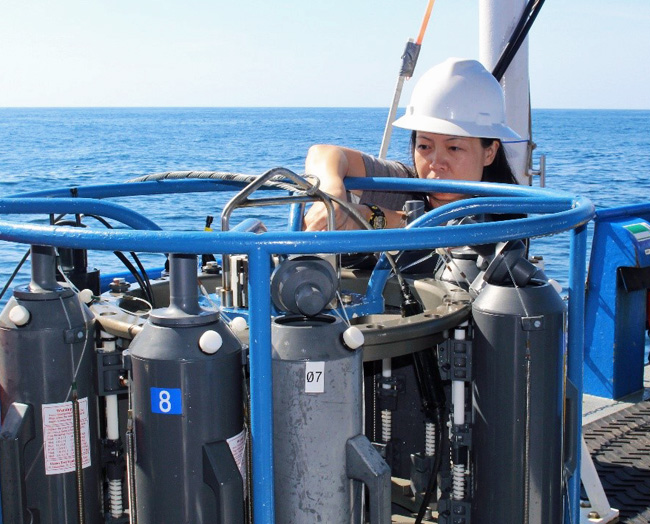
Kun Ma cocking the Niskin bottles on a Conductivity-Temperature-Depth array.

Ma is a new University of Georgia doctoral student at Skidway, working mainly on a National Science Foundation-funded photochemistry project with professors Jay Brandes and Aron Stubbins. This was her first science cruise and she collected some particulate organic matter and dissolved inorganic carbon samples. She also helped Skidaway Institute researcher Bill Savidge by collecting some chlorophyll samples in order to calibrate the chlorophyll sensor on the CTD instrument, an instrument used to collect water samples and measure those samples’ properties, such as Conductivity (a proxy for salinity), Temperature and Depth.

Lixin Zhu in immersion suit during safety trainning

Zhu is a visiting doctoral student in Aron Stubbins’s lab from East China Normal University. He collected filtered water samples on the cruise. Zhu will analyze the color and fluorescence of dissolved organic matter, and dissolved black carbon concentrations. In addition, Zhu performed solid phase extraction and collected high-resolution real-time data on colored organic matter with the underway scientific computer system on the ship. Eventually, he will combine these data with other field data collected in the South Atlantic Bight area to see the overall dynamics of dissolved black carbon.

“I am glad that we overcame seasickness, and it’s really cool to see that the glider team controlled six gliders at the same time aboard,” Zhu said. “Furthermore, their working approach and decision making process, based on real-time data, modeling and satellite results, impressed me a lot.”

Savannah Science Seminar students learn about Skidaway Institute research

A group of local high school students got an up-close look at oceanography through a special program at UGA’s Skidaway Institute of Oceanography. The students were participants in the Savannah Science Seminar, a nine-month-long program designed to promote an understanding and appreciation for science through informative, participatory presentations and hands-on workshops in the fields of engineering, technology, mathematics and medicine.

Julia Diaz profiles some of her research.

Their March 27 visit to Skidaway Institute exposed them to some of the topics studied and techniques used in marine research.

Skidaway Institute scientist Julia Diaz organized the evening’s program. After an introductory talk by researcher Jim Sanders, the students were split into three groups that rotated among three science stations.

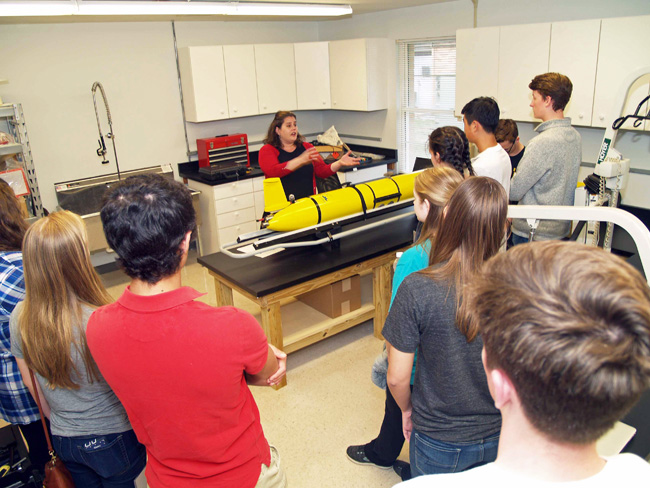
Physical oceanographer Catherine Edwards explained the workings of autonomous underwater vehicles.

Catherine Edwards describes an AUV.

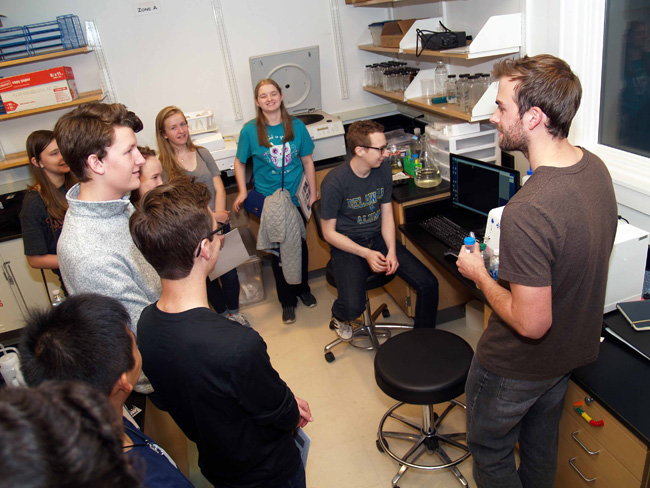
Graduate students Patrick Duffy and Sean Anderson demonstrated the new LIME imaging lab.

Patrick Duffy (2nd from right) and Sean Anderson (far right) introduce the students to cutting edge microbial imaging instruments.

Diaz and grad student Sydney Plummer discussed eutrophication and phytoplankton blooms.

Skidaway Institute participates in Earth Day

UGA Skidaway Institute scientists Elizabeth Harvey (l) and Sasha Wagner ready to greet visitors at Earth Day celebration.

A team from Skidaway Institute participated in Savannah’s Earth Day celebration in Forsyth Park on Saturday, April 15. Manning an information booth, the group interacted with hundreds of visitors at the event and passed out copies of Skidaway Campus Notes newsletters and Skidaway Institute stickers. The participants included Elizabeth Harvey, Sasha Wagner, Lee Ann Deleo, Aron Stubbins, Thais Bittar, Dana Savidge, Julia Diaz, Christina Codden and Mike Sullivan.

Gray’s Reef teams with GPB to present “Live Exploration”

Gray’s Reef National Marine Sanctuary, in collaboration with Georgia Public Broadcasting, created a livestream virtual dive event on May 10 from the UGA Marine Education Center and Aquarium. More than 35,000 viewers from as far away as Romania tuned in from their homes, schools and offices to dive into a 30-minute virtual field trip of Gray’s Reef, located approximately 20 miles off the coast of Georgia’s Sapelo Island. The virtual expedition included underwater surgery on a fish to insert a tagging transmitter and beautiful views of the vibrant and abundant marine life found at Gray’s Reef. Viewers learned how Gray’s Reef was formed, how the seafloor serves as a habitat and how they can help protect the reef from threats.

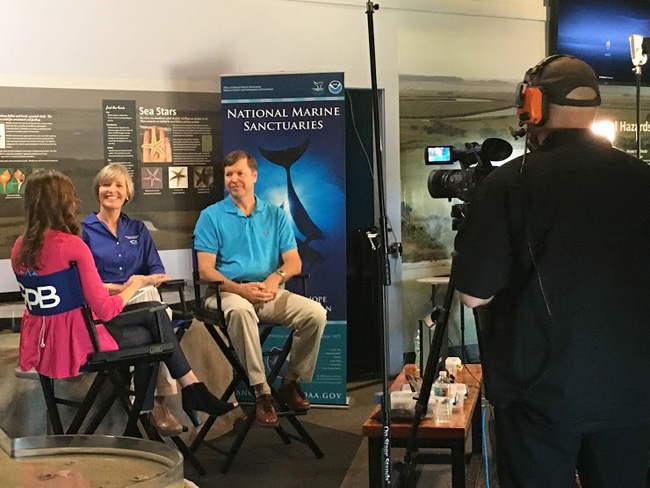
GPB host Ashley Mengwasser, GRNMS Superintendent Sarah Fangman and UGA research scientist Scott Noakes discuss Gray’s Reef National Marine Sanctuary during the livestream. Photo M. Riley/GRNMS

The sanctuary’s communications coordinator, Michelle Riley, worked with GPB’s Education division in Atlanta to create the event using underwater footage of Gray’s Reef and featuring sanctuary superintendent Sarah Fangman and UGA researcher Scott Noakes as experts. Emily Woodward and her colleagues at UGA Marine Extension and Georgia Sea Grant provided substantial support to the event, and aquarium staff updated the tanks with a colorful new interpretation of Gray’s Reef. UGA’s Skidaway Institute of Oceanography provided technical assistance, utilizing the expertise of senior system administrator Wayne Aaron.

Targeted to students, the livestream included a question-and-answer session with Fangman and Noakes, during which viewers submitted more than 1,000 questions. The event was accompanied by supplemental materials tailored to Georgia Department of Education standards for K-12. GPB had hoped for an audience of 3,000 – 5,000, and was pleased that the participation level was substantially higher than originally expected.

To view the archived event, go to http://www.gpb.org/education/explore/grays-reef.

Skidaway Island Marathon organizers support UGA Skidaway Institute

The organizers of the 2017 Skidaway Island Marathon recently presented a donation of $600 to the Associates of Skidaway Institute. Endurance Race Services organized the March 25 race, which had both its start and finish lines on the UGA Skidaway Marine Science Campus. The marathon organizers support a number of area nonprofits with the race proceeds. This was the third year the Skidaway Island Marathon was based out of the Skidaway campus.

Dan Pavlin (l) from Endurance Race Services presents a check to Skidaway Institute interim executive director Clark Alexander.

Jay Brandes collaborator on research paper

UGA Skidaway Institute professor Jay Brandes is a collaborator on a recent publication focusing on the roles of methane, iron and microbes in regulating the temperature of the primordial ocean. The research team was led by Georgia Tech Ph.D. student Marcus Bray. An article describing the project, can be found here.


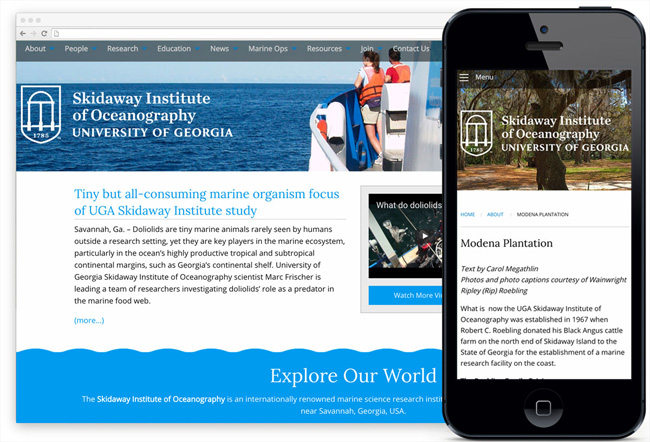
UGA Skidaway Institute launches new website

UGA’s Skidaway Institute of Oceanography launched its new website in April. Keeping the old URL, www.skio.uga.edu, the new site is more functional and visually appealing. The site was designed by Heideldesign, a Savannah-based firm, and the content was created by the Skidaway Institute’s staff.The new site is easily navigable and uses photography from the Skidaway Institute campus. It utilizes a blue color pallette and wave graphics to reflect the institute’s focus on the ocean world.

The main site content is divided into the research center’s four disciplinary areas, allowing visitors and prospective and current students to dig in deeper to the study area of their choice. Faculty members have their own profile pages as well as lab pages, and each faculty member can log on to the site and add information, files, videos and photos. In addition, the site provides a wealth of content, including images and videos, on Skidaway Institute research, operations, outreach and resources.

The new site is powered by the content management system WordPress, which means administrators can also easily add news releases, publications and other information, keeping site content fresh and up to date.