Tag Archives: research

Skidaway Institute participates in worldwide ocean snapshot

Scientists at the University of Georgia Skidaway Institute of Oceanography joined researchers around the globe in a worldwide Ocean Sampling Day on Sunday, June 21, the summer solstice.

This was the second year Skidaway researchers have participated in the Ocean Sampling Day event. The first was conducted last year, also on the summer solstice. The event focuses on simultaneous sampling of microbes in ocean, coastal and Great Lakes waters.

This year, 191 marine research locations—from the Rothera Research Station in Antarctica to Göteborg University in Sweden—participated. The sampling program supports international missions to provide

“It’s a global effort to take a snapshot of microbes across the world’s oceans at the same time, on the same day, in this case, the summer solstice,” said Skidaway Institute professor Marc Frischer.
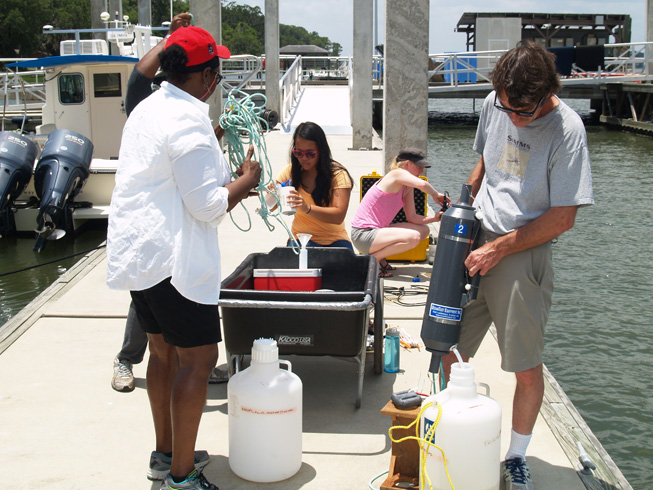
The Skidaway Institute team transfers a water sample from the Skidaway River during Ocean Sampling Day

The Skidaway Institute team transfers a water sample from the Skidaway River during Ocean Sampling Day

Frischer cited the significance of the project by describing microbes as the “engines of our planet” and said half the oxygen in the atmosphere is produced by microbes in the ocean.

Skidaway Institute scientists collected samples at two locations. One team collected and processed samples from the Skidaway River estuary immediately adjacent to the Skidaway Institute campus. That also served as part of an ongoing water-quality monitoring program Skidaway Institute has supported for more than 25 years. A second group teamed up with scientists from the National Oceanic and Atmospheric Administration Gray’s Reef National Marine Sanctuary and collected samples from Gray’s Reef. The 14,000-acre marine sanctuary is located about 17 miles off the Sapelo Island coast.

“We helped Gray’s Reef by collecting and processing their samples in the way they needed to be done,” Frischer said. “You really need a laboratory for that, and we were able to provide that.”

One goal of the global project is to note the commonalities and the differences among the microbial communities around the globe. Some of those differences were seen just in the samples collected at Gray’s Reef and at the Skidaway campus, two sites only 40 miles apart.
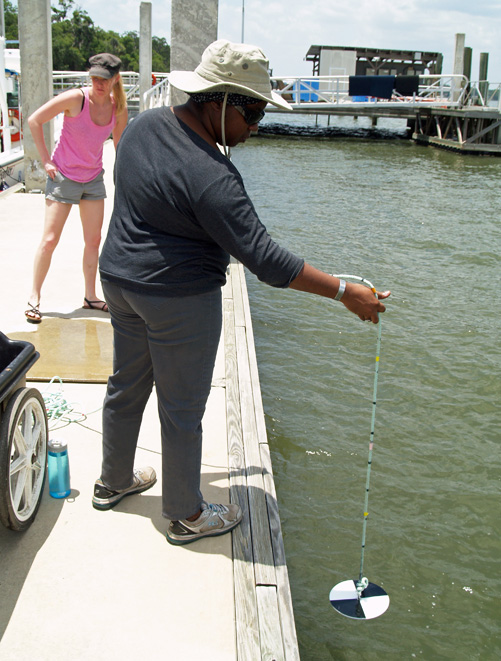
Grad student LaGina Frazier lowers a disc used to measure turbidity into the water off the UGA Skidaway Institute dock.

Grad student LaGina Frazier lowers a sensor into the water off the UGA Skidaway Institute dock.

“We generally observe a larger number of smaller organisms out in the ocean, which makes sense because they are adapting to a system with lower nutrients,” Frischer said. “We also saw a different kind of photosynthetic organisms since there is much more light available in the ocean compared to rather turbid waters in our estuary.”

Much of the fieldwork at both Skidaway Institute and Gray’s Reef was handled by undergraduate college students gaining research experience at Skidaway Institute this summer. These included students from UGA and Savannah State University’s Research Experience for Undergraduates program.

All samples and data were sent to Bremen, Germany, for DNA extraction and sequencing to ensure maximum comparability. The resulting data will be made publicly available as soon as quality checks are finished. These cumulative samples, related in time, space and environmental parameters, will provide insights into fundamental rules describing microbial diversity and function and contribute to the blue, or oceanic, economy through the identification of novel, ocean-derived biotechnologies.

Ocean Sampling Day was jointly coordinated by Jacobs University in Bremen, Germany, and the University of Oxford in the U.K. and is part of the European Union-funded Ocean of Tomorrow research project Micro B3.

“It is really important to have a global perspective,” Frischer said. “We are glad we can participate in what they are now calling “gigascience” where we are collecting a snapshot from all over the world. It is amazing!”

Additional information on the global Ocean Sampling Day project is available at www.microb3.eu/osd.

A video of Ocean Sampling Day is available on the Skidaway Institute YouTube Channel at:

https://www.youtube.com/watch?v=5c8JuzvLUH8

UGA Skidaway Institute scientists conduct winter 26-hour sampling program

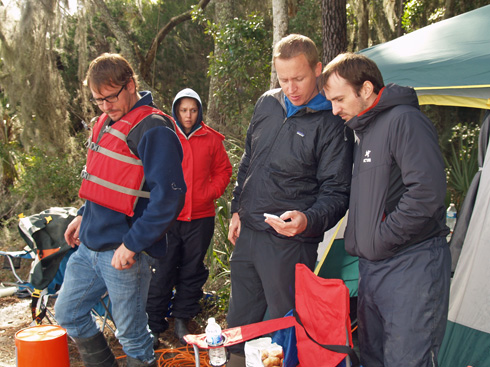
On the weekend of January 24th, a team lead by UGA Skidaway Institute scientist Aron Stubbins conducted the latest “26 Hours on the Marsh” sampling program on the bluff at Groves Creek on the Skidaway Institute campus. The project was designed to investigate how salt marshes function and interact with their surrounding environment—specifically how bacteria consume and process carbon in the marsh. The team collected water samples throughout two complete tidal cycles, during both the day and night.

The outdoor laboratory on the bluff at Groves Creek.

The outdoor laboratory on the bluff at Groves Creek.

Skidaway Institute's Zac Tait, Thais Bittar, Rob Spencer (FSU) and Aron Stubbins prepare for a sample collection.

Skidaway Institute’s Zac Tait, Thais Bittar, Rob Spencer (FSU) and Aron Stubbins prepare for a sample collection.

Zac Tait collects a water sample from a skiff tied to the bank.

Zac Tait collects a water sample from a skiff tied to the bank.

Thais Bittar and Zac Tait begin to process the water sample.

Thais Bittar and Zac Tait begin to process the water sample.

About a dozen scientists and students were involved in the project. “26 Hours on the Marsh” is supported by two grants from the National Science Foundation. The grants total $1.7 million that represent larger, three-year, multi-institutional and multi-disciplinary research projects into salt marsh activity. These projects bring together faculty, students and staff from UGA’s Skidaway Institute, the University of Tennessee, Florida State University and Woods Hole Research Center. UGA Skidaway Institute scientists include principal investigator Jay Brandes; chemical oceanographers Aron Stubbins and Bill Savidge; physical oceanographers Dana Savidge, Catherine Edwards and Jack Blanton; and geologist Clark Alexander.

UGA study finds high marine debris, need for standardized reporting along Georgia coast

By Molly Kate Berg

University of Georgia researchers are hoping to find a consistent way to record the marine debris—particularly pieces of plastic—crowding Georgia’s beaches as part of an effort to find a solution for the growing problem.

Marine debris has been washing up on Georgia beaches and uninhabited islands for years. Combating the issue starts with figuring out how big it is, and a new two-part study from the UGA Skidaway Institute of Oceanography and Marine Extension published online in the Marine Pollution Bulletin finds that marine debris reporting can improve if it becomes standardized.

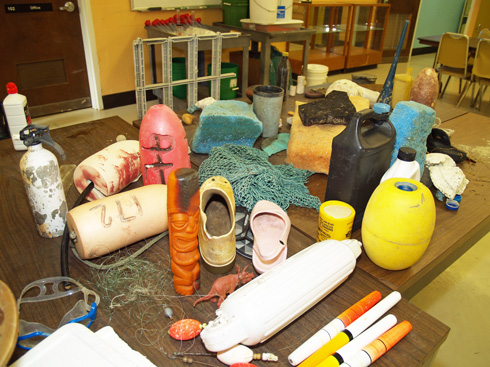
A sample of marine debris collected along the Georgia coast sits on a table at the UGA Marine Education Center and Aquarium.

A sample of marine debris collected along the Georgia coast sits on a table at the
UGA Marine Education Center and Aquarium.

The problem right now is this: A volunteer group goes out and records the weight or volume of the marine debris collected. However, volunteers don’t often record the specific square feet measured or the contents of the debris. Due to a lack of report standardization, researchers often can’t compare the marine debris, especially plastic fragments, reported by different groups.

“We’ve seen plastic usage go up dramatically,” said study co-author Dodie Sanders, a marine educator and outreach coordinator for UGA Marine Extension, a unit of the Office of Public Service and Outreach. “It’s an important 21st century global issue. We need to learn more to better understand the issues of marine debris.”

The study’s lead author Richard F. Lee, professor emeritus with the UGA Skidaway Institute of Oceanography, agrees.

“Plastic debris is created on land and then it goes into rivers, flows into the ocean and washes up on land,” he said. “We’ve found that plastic debris ends up not only on populated beaches, but on inaccessible islands as well. We’ve found plastic everywhere on the coast.”

The first part of the study gathered debris from 20 sites along Georgia’s coast, including Tybee, Cumberland and Ossabaw islands. The debris was reported from volunteer organizations like Clean Coast, which hold monthly beach and marsh cleanups in Georgia.

“The volunteer groups reported the weight of the debris, though we didn’t know the exact amount of plastic,” Lee said. “Based off the volunteer information we received, we did a follow-up study to more precisely measure the marine debris in a fixed location and period of time.”

The total collected debris ranged from 180 to 1,000 kilograms. The levels of plastic debris differed at each site over the course of the study, though plastic was consistently among the mix. Found plastic included bottles, wrappers, food utensils and fragments of fishing gear.

Sanders spearheaded the second part of the study, where she and students collected plastic debris from Skidaway and Wassaw islands over a period of two years.

“While Dr. Lee did data analysis, I did some of the field work,” Sanders said. “We picked the two islands in the second part of the study because they were accessible sites where Marine Extension often takes students for marine education.”

For the fieldwork, Sanders and students visited the islands each month. They took inventory of what kinds of plastics were on specific areas of the coast.

“On about a monthly basis, I would take students to learn about debris and tally all the items on the islands,” Sanders said. “We took areas of 200 meters by 40 meters and recorded the items found. We also used GPS units to mark what areas we had done.”

The students, many of them in middle and high school, came from all over Georgia to assist. As part of Marine Extension, Sanders regularly teaches visiting students about marine life. When students volunteered to clean up, she tried to emphasize the issues surrounding debris.

“The bulk of the plastic comes from land,” Sanders said. “When people think of marine debris, they think of the ocean. I try to emphasize watershed concepts—what happens upstream ultimately gets downstream.”

“It can take years for plastic to degrade,” Lee said, adding, “80 percent of the plastic found at Wassaw turned out to be fragments. The fragments then spread and can have a number of environmental effects.”

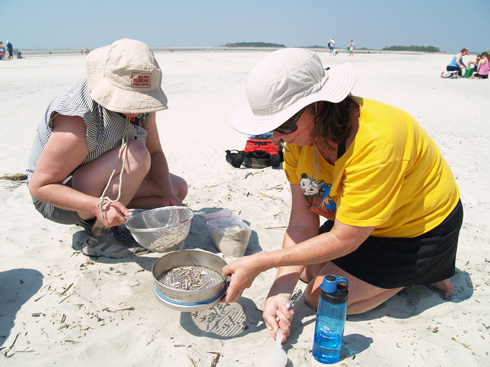
Participants in a July 2014 teacher’s workshop focusing on marine debris sift through the sands of Tybee Island in search of microplastic particles.

Participants in a July 2014 teacher’s workshop focusing on marine debris sift
through the sands of Tybee Island in search of microplastic particles.

Sanders says that since plastic debris is everywhere on the coast, it has to be addressed and reported efficiently to reduce its effects.

“There are proactive and reactive approaches to the issues of marine debris, and both are important,” she said. “We’ve been reactive so far by picking up debris. The proactive approach is our role in educating the public and researching the negative impacts of marine debris.”

The study was supported by the Georgia Department of Natural Resources Coastal Incentive Grant, NOAA Southeast Atlantic Marine Debris Initiative and the NOAA Marine Debris Program.

The full article on “The amount and accumulation rate of plastic debris on marshes and beaches on the Georgia coast” is available at www.sciencedirect.com/science/article/pii/S0025326X14008200#.