UGA Skidaway Institute scientists study microbial chemical warfare

In the battlefield of the microbial ocean, scientists have known for some time that certain bacteria can exude chemicals that kill single-cell marine plants, known as phytoplankton. However, the identification of these chemical compounds and the reason why bacteria are producing these lethal compounds has been challenging.

Now, University of Georgia Skidaway Institute of Oceanography scientist Elizabeth Harvey is leading a team of researchers that has received a $904,200 grant from the National Science Foundation to fund a three-year study into the mechanisms that drive bacteria-phytoplankton dynamics.
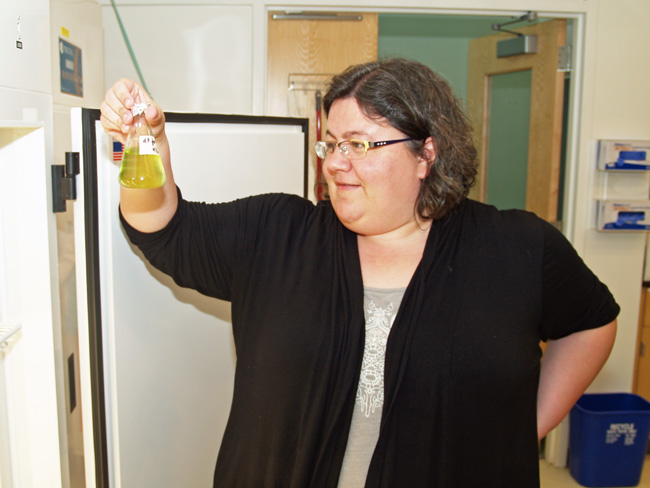
Researcher Elizabeth Harvey examines a part of her phytoplankton collection.

Understanding these dynamics is important, as phytoplankton are essential contributors to all marine life. Phytoplankton form the base of the marine food chain, and, as plants, produce approximately half of the world’s oxygen.

“Bacteria that interact with phytoplankton and cause their mortality could potentially play a large role in influencing the abundance and distribution of phytoplankton in the world ocean,” Harvey said. “We are interested in understanding this process so we can better predict fisheries health and the general health of the ocean.”

A microscopic view of a population of phytoplankton.

This project is a continuation of research conducted by Harvey and co-team leader Kristen Whalen of Haverford College when they were post-doctoral fellows at Woods Hole Oceanographic Institution. They wanted to understand how one particular bacteria species impacted phytoplankton.

“We added the bacteria to the phytoplankton and the phytoplankton died,” Harvey said. “So we became very interested in finding the mechanism that caused that mortality.”

They identified a particular compound, 2-heptyl-4-quinlone or HHQ, that was killing the phytoplankton. HHQ is well known in the medical field where it is associated with a bacterium that can cause lung infections, but it had not been seen before in the ocean. The team will conduct laboratory experiments to determine the environmental factors driving HHQ production in marine bacteria; establish a mechanism of how the chemical kills phytoplankton; and use field-based experiments to understand how HHQ influences the population dynamics of bacteria and phytoplankton.

“This project has the potential to significantly change our understanding of how bacteria and phytoplankton chemically communicate in the ocean.” Harvey said.

The project will also include a strong education component. The researchers will recruit undergraduate students, with an effort to target recruitment of traditionally under-represented groups, to participate in an intense summer learning experience with research, field-based exercises and some classroom work.

“The idea is for the students to return to their home institutions at the end of the summer, but to continue to work with us on this project,” Harvey said. “This will be a unique opportunity to offer students cross disciplinary training in ecology, chemistry, microbiology, physiology and oceanography.”

In addition to Harvey and Whalen, the research team includes David Rowley of the University of Rhode Island.
UGA Skidaway Institute grad student receives master’s degree

Former UGA Skidaway Institute and Savannah State University graduate student Ashleigh Price successfully defended her master’s thesis before her committee and a public audience on November 8.

She officially received her degree on Dec. 10.

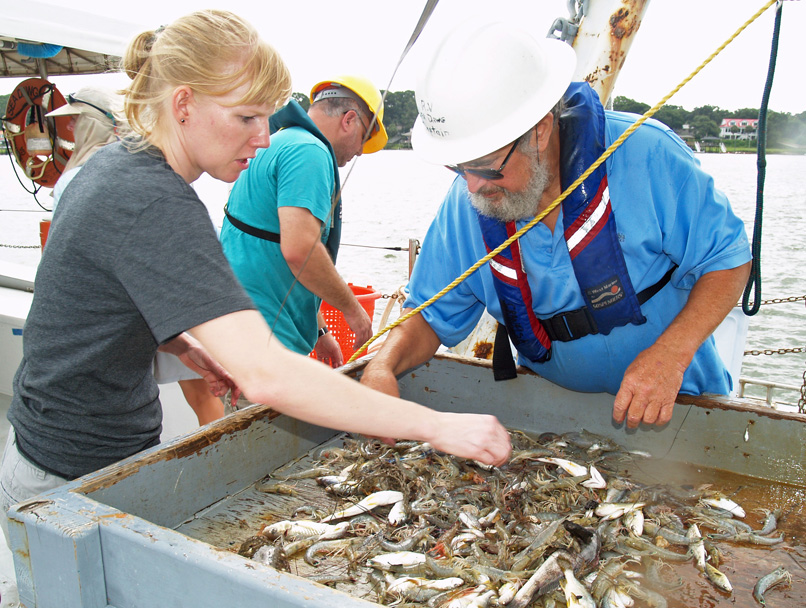
Ashley Price sorts the product of a trawl with John "Crawfish" Crawford on board the UGA Research Vessel Sea Dawg.

Ashley Price sorts the product of a trawl with John “Crawfish” Crawford on board the UGA Research Vessel Sea Dawg.

Ashleigh did most of her research as part of Marc Frischer’s lab at Skidaway Institute. The title of her thesis is “Environmental Reservoirs and Mortality Associated with Shrimp Black Gill.”

The Roebling barn in perspective

by Debbie Jahnke

Editor’s notes: Debbie and Rick Jahnke were longtime members of the Skidaway Institute family. Rick was a faculty scientist and, for several months, interim director of the institute. Debbie was his research coordinator. They both retired in 2008 and moved to Port Townsend, Washington.

 In March of this year, the Georgia General Assembly approved a $3 million bond issue to renovate and repurpose the old Roebling cattle show barn at UGA Skidaway Institute into usable laboratory and meeting space.

In 1986, Rick Jahnke interviewed for a faculty position at Skidaway Institute of Oceanography. At the time, he was a research scientist at Scripps Institution of Oceanography. Rick returned home to San Diego with the impression that he wouldn’t be hired because Stuart Wakeham had also interviewed for the position and would undoubtedly be selected. Instead, Skidaway Institute came up with the funds for two positions and hired both Rick and Stuart.

Rick’s start-up requests to Skidaway Institute were modest: a germanium detector and a desktop computer. He also requested lab and office space in the Roebling building and a staging lab in the barn for maintenance, repair and modification of his various seagoing autonomous vehicles. The barn was nearly perfect for that purpose, with plenty of storage space and a central open area that allowed loading and offloading of equipment with a hand-winched pulley system.OLYMPUS DIGITAL CAMERA

Rick didn’t need any extra space for me and, instead, split his office with a wall so there was a spot just big enough for my desk and a “labradog” named Daisy. I was the analytical tech for his research and he hired an equipment tech for the seagoing operations. The barn lab operations expanded to the second floor of the barn when it became clear that anyone interested in measuring natural levels of C-14 wasn’t going to be able to do it in many existing Skidaway Institute labs. In the free-form early days of productivity measurements, enough C-14 made it into the ambient spaces of many Skidaway Institute labs that C-14 dating indicated that our labs existed about 50,000 years in the future. The levels of so-called contamination were in no way concerning for health or safety, but they made natural abundance measurements impossible without a “clean” space for sample storage. The bright yellow room with the pink and green interior and cold room on the second floor of the barn were the result.

The interior today

The interior today

From those barn labs, autonomous vehicles were staged, packed and deployed for oceanographic research off western Africa, Peru, Panama, New Guinea, deep shelves off Cape Hatteras, California, Oregon and other locations, as well as the Georgia shelf. Samples were returned and stored in the yellow lab upstairs.

The barn provided another opportunity for me when I was drafted in a weak moment to try to improve what was quite dismal visitor housing at Skidaway Institute in the 1980s. The first housing we made habitable was the barn apartment. As we worked through the process of getting three NSF grants for housing, we also were able to set up a small laundry room in the barn so that volunteers could keep clean linens in the housing we did have. The first successful grant built the quadraplex (Menzel, Zeigler, Carpenter and Knight apartments). The second grant rehabilitated the housing that existed since the plantation days (the barn apartment, now renamed Baggett, Rice House, Thomas and Martin apartments). The third grant built the Commons. I spent many hours in that barn laundry room while most of my weekends and holidays were spent cleaning housing units before the institute finally figured out how to pay someone to do that as a real job.

Rick and I retired in 2008 and headed west with our five cats. All I know of the modern Skidaway Institute is what I read on the website and Facebook pages and occasional emails from friends still there. Skidaway was wonderful to us and the barn was a big part of the ease with which our research was facilitated. It was with considerable pleasure that we learned of the grand and useful future being planned for the good old barn.

Skidaway Institute research team participates in GIS Day

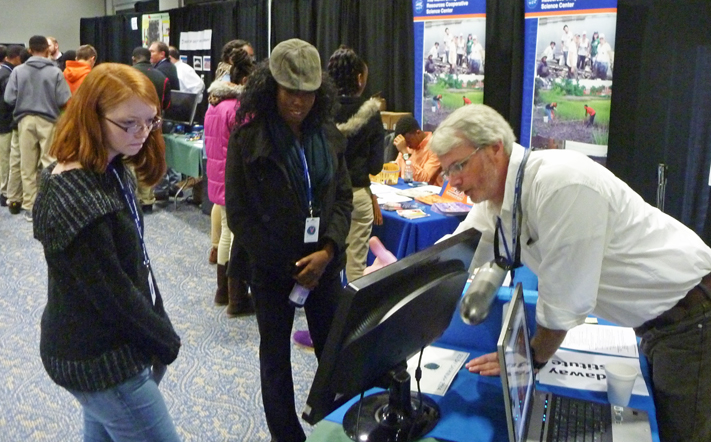
UGA Skidaway Institute’s Clark Alexander’s lab participated again as a sponsor of the GIS Day event hosted by Savannah Area Geographic Information System on the Savannah State University campus.

Mike Robinson demonstrates GIS to two attendees.

Mike Robinson demonstrates GIS to two attendees.

This year marked the 10th year for the event which introduced 450 eighth-grade students along with area business owners, staff, GIS users and citizens from the local community to demonstrations of real-world applications that are making a difference in our society.

GIS Day is celebrated internationally as part of National Geographic’s International Geography Week. The National Geographic Society has sponsored Geography Awareness Week since 1987 to promote geographic literacy in schools, communities and organizations, with a focus on the education of children.

Registration is now open for the 2017 Youth Ocean Conservation Summit

UGA Marine Extension and Georgia Sea Grant is hosting Georgia’s third annual Youth Ocean Conservation Summit on Saturday, Jan. 28, at the Marine Education Center and Aquarium on Skidaway Island. This summit, one of several taking place across the country, empowers students with the knowledge, skills and resources necessary to successfully implement ocean conservation projects.

The event will include skill-building workshops, brainstorming sessions, citizen science presentations and panels featuring professionals working on coastal issues in Georgia. At the end of the day, students will work together to develop and present ideas for conservation efforts that they could lead in their local communities. The event is being organized by the 2016-2017 Georgia Sea Grant Marine Education Interns Kira Krall, Hannah Kittler, Hannah Edwards and McKenna Lyons.

Online registration opens Dec. 5 and closes Jan. 18. The summit is limited to 50 students on a first-come, first-served basis. A $10 registration fee includes lunch and all materials. To register, complete the online registration form and payment.

For more information, visit the Marine Extension and Georgia Sea Grant website http://marex.uga.edu/yocs/.


Georgia Sea Grant seeks applicants for 2018 Knauss Marine Policy Fellowship

The Georgia Sea Grant College Program is taking applications for the 2018 Knauss Marine Policy Fellowship, which places graduate students for a year in various executive and legislative branch offices throughout Washington, D.C.

pagetop_knaussfellowship_647_255-1The fellowship provides a unique educational experience in the policies and processes of the federal government to students who have an interest in ocean, coastal and Great Lakes resources and in the national policy decisions affecting these resources. The fellowship period begins Feb. 1, 2018, and ends on Jan. 31, 2019.

Any graduate student, regardless of citizenship, who on Feb. 10, 2017, is enrolled in an academic institution in Georgia is eligible to apply. A full list of application materials and additional information on eligibility can be found online at:

http://seagrant.noaa.gov/Portals/0/Documents/funding_fellowship/knauss_fellowship/prospective/NOAA-OAR-SG-2018-2004993%20Full%20Announcement.pdf

Applications must be submitted to Georgia Sea Grant by 5 p.m. on Feb. 10, 2017, via its online submission system, eSeaGrant, that can be accessed using the following link http://eseagrant.uga.edu/index.php

Potential applicants are also encouraged to contact Mona Behl, associate director of UGA Marine Extension and Georgia Sea Grant, at 706-542-6621 or mbehl@uga.edu to discuss application content and submission. For more information on applying for the Knauss Fellowship, please visit the Georgia Sea Grant website at http://georgiaseagrant.uga.edu/article/knauss_marine_policy_fellowship/


14th Annual Gray’s Reef Film Festival expands to Tybee Island and adds second 3D Night

by Michelle Riley / Gray’s Reef NMS

Moviegoers gave rave reviews to the Gray’s Reef Film Festival’s first-ever “3D Night” last year, spurring Gray’s Reef National Marine Sanctuary to offer two consecutive nights of 3D fun at the Trustees Theater in downtown Savannah for the upcoming festival. The sanctuary also is expanding the event’s reach by adding a daytime slate at the Tybee Post Theater.

“We’re having a lot of fun putting together this year’s festival,” organizer Chris Hines, deputy superintendent of Gray’s Reef, said.  “Our theme this year is ‘Our Community, Our Ocean.’ These beautiful movies highlight the deep bond with nature and the ocean we are so fortunate to experience as a coastal community, and how important a healthy ocean is to preserving our way of life.”

On tap for the 3D showings at the Trustees Theater Feb. 3-4 are “Galapagos 3D: Nature’s Wonderland,” “The Last Reef 3D,” “Wonders of the Artic 3D” and “Secret Ocean 3D.” “Galapagos 3D” is directed by award winner Martin Williams, who is well known for his documentaries with David Attenborough. “The Last Reef 3D” was shot in five countries and is the production of Academy Award nominees Luke Cresswell and Steve McNicholas, while “Wonders of the Arctic 3D” is a sweeping film by David Lickley, who describes himself as a “wilderness environmental-themed filmmaker. “Secret Ocean 3D” is a beautiful jewel of a movie by Jean-Michel Cousteau.

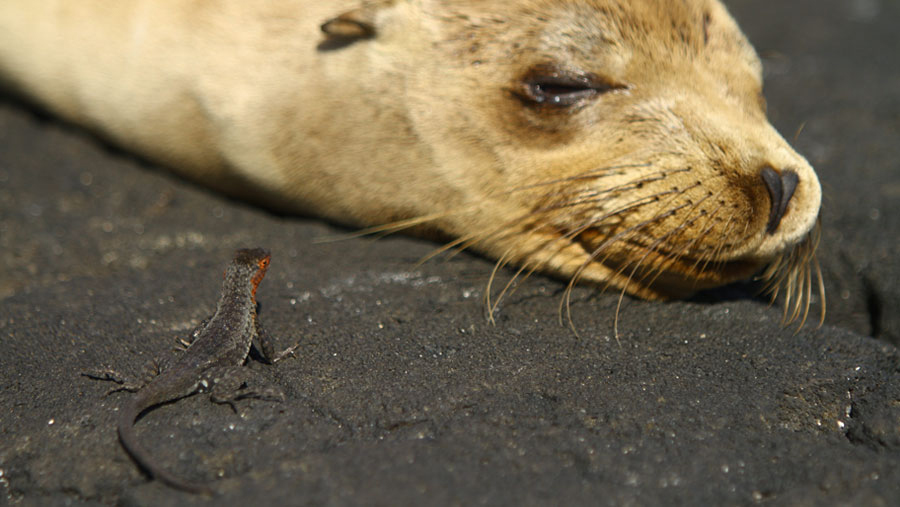
Galapagos sea lion and lava lizard from "Galapagos 3D"

Galapagos sea lion and lava lizard from “Galapagos 3D”

The Tybee Post Theater offerings on Feb. 5 will include a delightful sampling of films from the San Francisco International Ocean Film Festival, the premier venue in North America for ocean-related movies, most of which are largely unavailable to the general public.

“Our partnership with the Tybee Post Theater this summer exceeded our expectations, with more than 1,000 attendees expressing their interest in ocean-themed movies,” said Hines. “We are excited to expand the film festival and deepen our engagement with our beach communities.”

Like last year, Gray’s Reef suggests a donation of $10 per day for adults, $5 per day for children, students and military, to benefit the Gray’s Reef National Marine Sanctuary Foundation. The foundation will host a pre-festival party on Feb. 2, with limited tickets available.

K-12 teachers learn from Rivers to Reefs

by Michelle Riley / Gray’s Reef National Marine Sanctuary

In June, Gray’s Reef National Marine Sanctuary hosted the 13th annual Rivers to Reefs Workshop for Educators in association with the University of Georgia Skidaway Institute of Oceanography, the Georgia Aquarium and Gordon State College. Cathy Sakas, chair of the Gray’s Reef National Marine Sanctuary Foundation, and Kim Morris-Zarneke, manager of education programs at Georgia Aquarium, served as the primary leaders of the workshop, with assistance from Theresa Stanley of Gordon State College.  Michelle Riley from Gray’s Reef National Marine Sanctuary served as communications lead.

Rivers to Reefs is an educational expedition for teachers, focused on Georgia’s Altamaha River watershed. During the six-day trip, 16 Georgia science teachers canoed the Oconee, Ocmulgee and Altamaha rivers into the Sapelo estuary, crawled through salt marshes, traveled to Gray’s Reef and trawled the Wilmington River. They learned and explored the connections between the watershed and the ocean.

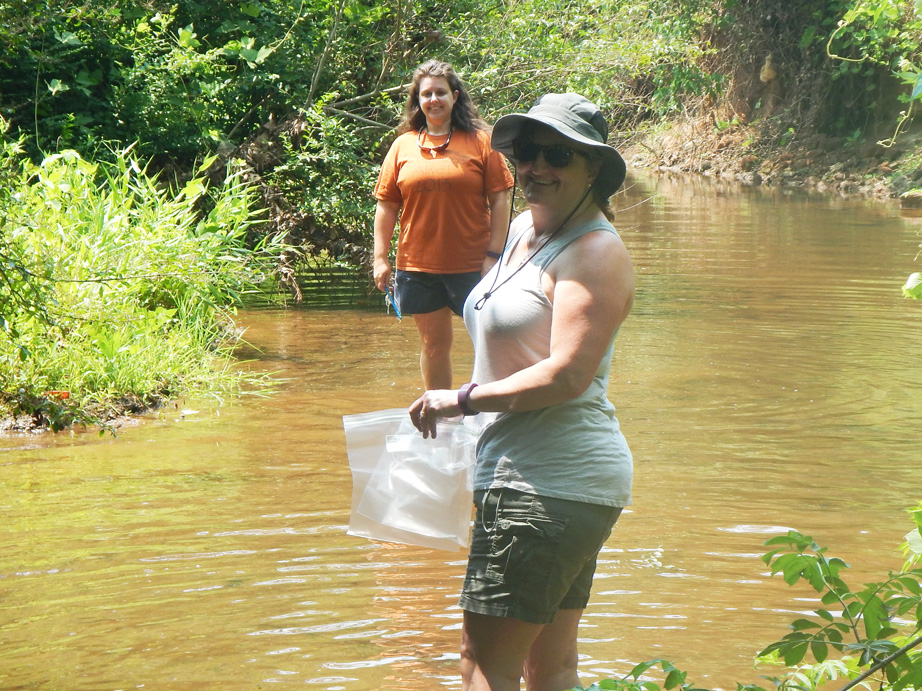
Teachers Marilyn Kinney (foreground) and Candace Bridges collect water samples in Flat Shoals Creek. Photo: Michelle Riley

Teachers Marilyn Kinney (foreground) and Candace Bridges collect water samples in Flat Shoals Creek. Photo: Michelle Riley

The week was packed with activities that most teachers never experience, beginning with a behind-the-scenes orientation at Georgia Aquarium, and it included an offshore trip to Gray’s Reef National Marine Sanctuary aboard the first working research vessel the educators had ever seen close up, Skidaway Institute’s R/V Savannah. In between, the group explored creeks, waterfalls, rivers and estuaries, and saw an abundance of flora and fauna. They frequently stopped to collect water samples, conduct water quality tests and record environmental factors to determine the overall health of the creeks and streams that flow to the river system. As the week progressed, the teachers developed an understanding of the profound influence the waters flowing through the Altamaha River watershed have on the health of Gray’s Reef and were inspired to teach their students about environmental responsibility and ocean literacy.

Always a highlight of the workshop, the marsh crawl on Sapelo Island was a memorable experience. The group sloshed on their bellies through the thick dark mud to learn why marshes are considered some of the most important and productive habitats on Earth. The estuary that encompasses the salt marsh, where the freshwater from the Altamaha River mixes with the saltwater of the Atlantic, is one of the largest estuary systems on the Atlantic coast.

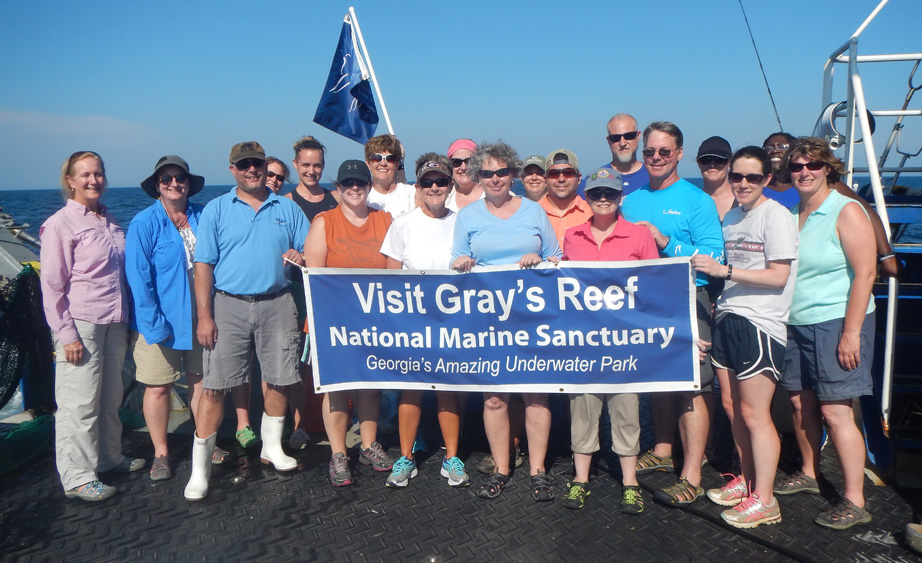
The teachers on board the Research Vessel Savannah.

The teachers on board the Research Vessel Savannah.

Waters were calm for the voyage out to Gray’s Reef National Marine Sanctuary on the R/V Savannah under the command of Capt. John Bichy, marine superintendent at UGA Skidaway Institute. With extensive assistance from the R/V Savannah crew, the teachers conducted water quality tests at three separate points in the ocean. Meanwhile, the ship’s crew pulled a trawl net through the ocean at midwater depth and brought in many interesting fish, a large pile of Georgia shrimp and a handful of sharks, including a hammerhead and a small Atlantic sharpnose shark. During the trip, the teachers were delighted when they were treated to lessons by professor Marc Frischer of Skidaway Institute on black gill in shrimp and on pelagic tunicates called doliolids. While in the sanctuary, the crew deployed an underwater camera to allow the teachers to see the reef and its sea creatures in real time, without getting wet.

On the final day of Rivers to Reefs, the teachers boarded UGA’s R/V Sea Dawg, a smaller vessel used by the UGA Marine Education Center and Aquarium, a unit of the UGA Marine Extension and Georgia Sea Grant. Capt. John “Crawfish” Crawford and Anne Lindsay, associate director for marine education, conducted a field class during the two-hour trawling voyage in the Wilmington River. The teachers recorded the catch for research purposes and ended their trip with a wrap-up by Frischer and the expedition leaders, before scattering across Georgia with great memories and a treasure trove of experiences to pass on to their students this fall.

Hundreds turn out to raise money for oyster hatchery

An oyster roast on the banks of the Skidaway River drew more than 200 people on a perfect fall night to celebrate and raise money for Georgia’s first oyster hatchery.

Guests used their commemorative Marine Extension and Georgia Sea Grant shuckers to crack open the wild oysters, served roasted and raw. Local chefs Matthew Roher of Sea Pines Resort and Dusty Grove from Pacci Italian Kitchen roasted Springer Mountain Farms chicken and vegetables.

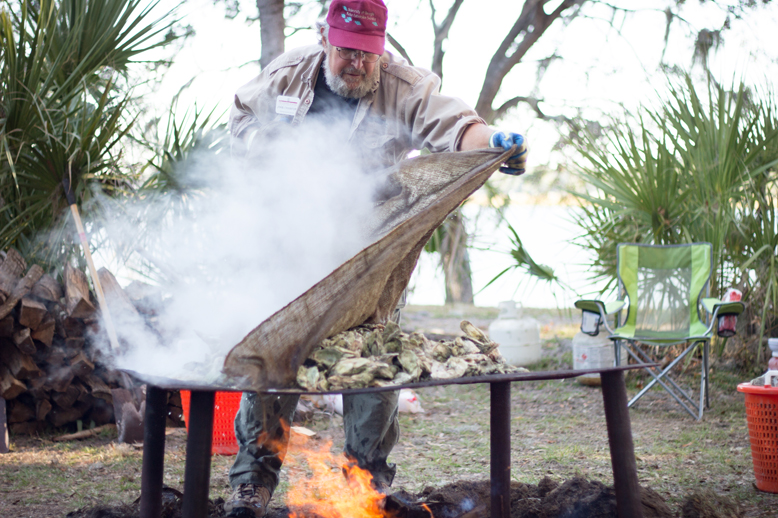
John "Crawfish" Crawford cooks a  batch of oysters.

John “Crawfish” Crawford cooks a batch of oysters.

SweetWater beer and music by the Accomplices rounded out the evening.

U.S. Rep. Buddy Carter, whose district includes Skidaway Island and Savannah, stopped by to enjoy the food and learn more about the hatchery.

“This is a terrific turnout and I’m encouraged by the support we are getting for the hatchery,” said Mark Risse, director of Marine Extension and Georgia Sea Grant.  “A lot of people don’t know it, but Georgia led the nation in oyster production in the early 1900s. We hope to be back at the forefront in the oyster industry in a few years, which would help the local economy by providing more aquaculture-related jobs.”

Supporters enjoy the oyster feast.

Supporters enjoy the oyster feast.

UGA launched the oyster hatchery on its Skidaway Marine Science Campus last year. There they create baby oysters, or spat, which are given to local aquaculturists with state permits to farm along the Georgia coast. So far, the hatchery has produced 700,000 spat, which have been given to 10 growers. The potential harvest value of those will be between $140,000 and $245,000.

By 2018, the hatchery is expected to produce between 5 million and 7 million spat per year, with an annual estimated value between $1 million and $2 million.

The goal is to attract a commercial hatchery and businesses related to oyster production to the area, which would provide jobs and greater economic development opportunities on the coast.

Program educates students about the impacts of marine debris to the coastal ecosystem

About 80 students and teachers from four coastal area schools know a bit more about microplastics and the impact they can have on sea life, thanks to a program launched by Marine Extension and Georgia Sea Grant and funded by the Landings Landlovers Inc.

Marine Educator Dodie Sanders began the Debris Detectives program to help young people better understand how microplastics, tiny fragments of plastic found in water and sediment, as well as marine debris negatively impact the coast.

Educator Dodie Sanders discusses microplastics with a class from St. Andrews School.

Educator Dodie Sanders discusses microplastics with a class from St. Andrews School.

Microplastics are ingested by organisms, such as fish, oysters and crabs, which then become imbedded in their digestive tracts. Little is known about the damaging effects of microplastics on marine life, though studies focused on this topic are being conducted around the world.

The students and teachers participating in the program went on a trawl aboard the R/V Sea Dawg and collected, sorted, identified and counted the organisms they caught, including shrimp, blue crabs and fish. Sanders discussed how microbeads in toothpaste and cosmetic products can end up in waterways and eventually in the stomachs of these marine organisms. They also collected water samples and took those back to the Marine Education Center lab to examine for the presence and abundance of microplastics.

Nick DeProspero, an environmental science teacher at St. Andrew’s School in Savannah, was with his students for the program. Prior to his position at St. Andrew’s, DeProspero worked at the UGA Marine Education Center and Aquarium as a Sea Grant marine education intern.

St. Andrews' students receive close instruction from teacher Nick DeProspero (right).

St. Andrews’ students receive close instruction from teacher Nick DeProspero (right).e as an education intern at the center, I saw the value in getting kids outside and engaging them in hands-on, interactive activities,” DeProspero said. “It was a great experience, which is why I bring my kids out here. Science is interactive and certainly isn’t best-learned through textbooks and lectures. Getting them out and working as a real scientist, especially right in their backyard, is crucial for them to making a connection between their role as a consumer and the environment.”

Not only does the Debris Detectives program cover subject matter that aligns with the classroom curriculum, it provides scientific sampling experience and teaches how to use scientific equipment to analyze data. This type of real-world application allows for a deeper understanding and awareness of how their daily actions may impact the important and fragile ecosystems along the Georgia coast. It also instills a sense of pride and ownership of these ecosystems, hopefully inspiring them to be environmental stewards of the Georgia coast.

Landings Landlovers Inc. is a nonprofit organization that promotes fellowship through social and cultural activities while working toward the continued improvement of community life at The Landings, a residential community on Skidaway Island, through its philanthropic efforts.